
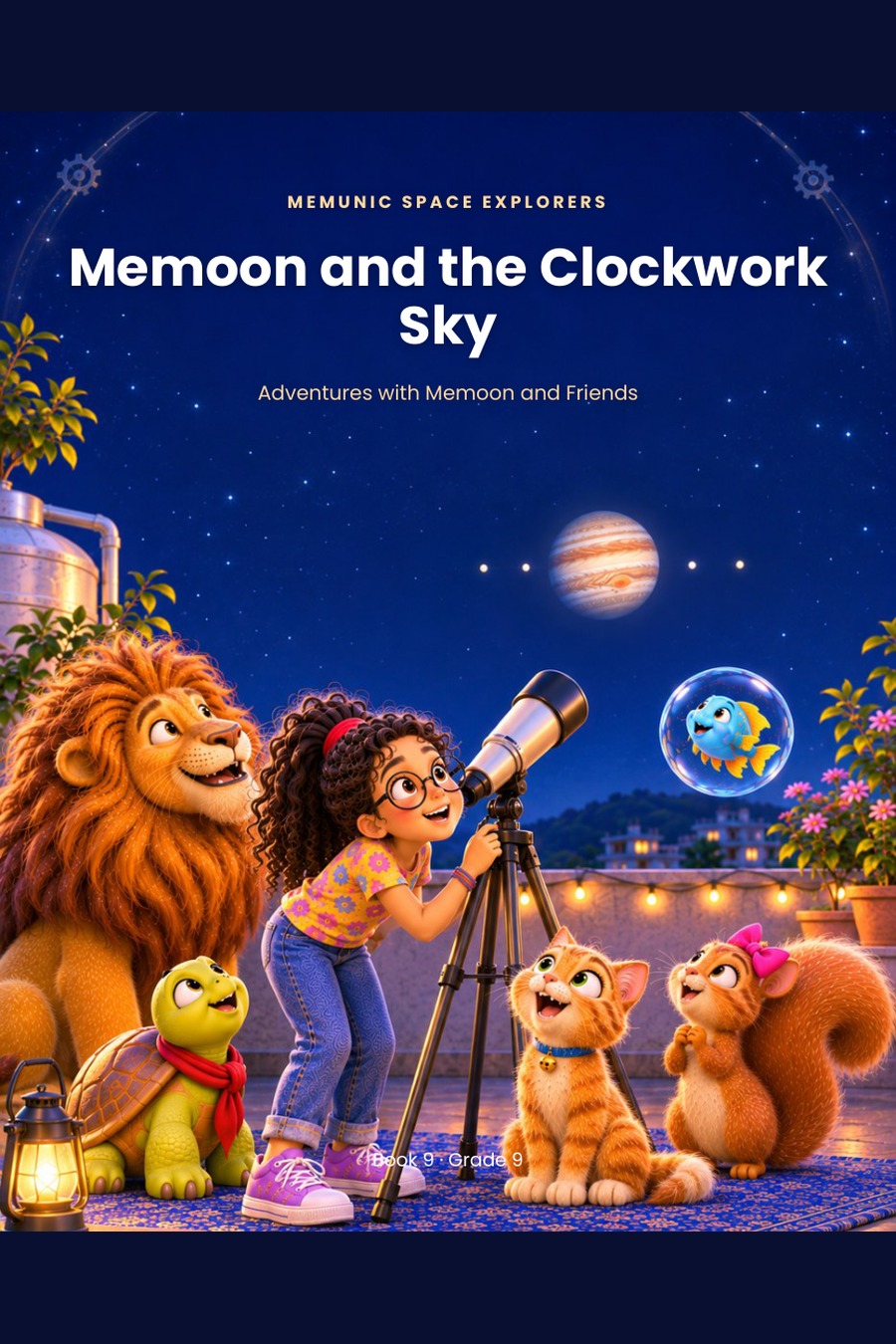
BOOK 9 OF 9 · GRADE 9 - AGES 14-15
Memoon and the Clockwork Sky
Beautine says the sky is clockwork. Can the Club predict its movements and measure how close they come?
Secure payment by Cashfree (UPI, cards, netbanking)
- 91 PDF pages
- 10 story chapters
- Grade 9
- Ages 14-15
- Illustrated
- Quiz and answers
About this book
Beautine arrives with a bold poster: THE SKY IS CLOCKWORK. Memoon and the Rooftop Sky Club turn the claim into tests, starting with the stars' apparent turn around Dhruva and the changing positions of Jupiter's moons. Every prediction must be written down before the observations begin.
Ten story chapters connect moon-position graphs with periods and amplitudes, Newton's laws, mass and weight, inverse-square gravity and orbits as falling sideways. An investigation of space-station passes shows why an orbital period is not a timetable for repeated passes over one home. Readers distinguish random and systematic error and report results with uncertainties.
Includes The Jupiter Moon Log project, a Data Detective badge, Sky Heroes, a Mistake Museum, a star-night guide and parent/teacher guidance. The matching 110-slide classroom PDF supports all ten chapters. Story pass times and some measurements are invented to explain the ideas, not live observing predictions.
How each chapter works
Illustrated story chapters combine Science Corners, Space Detective questions, diagrams and supervised activities. Readers test claims against evidence, explain model limits and use tables, graphs and calculations. Includes a recap, glossary, quiz with explained answers, project, Mistake Museum, observing guidance and a badge.
What they’ll learn
- Make a numerical prediction, compare it with observation and report an uncertainty range.
- Use repeated observations to distinguish Jupiter's moons from background stars.
- Graph moon positions, estimate period and amplitude, and recognise false patterns from sparse data.
- Apply Newton's laws and F = m a while keeping mass in kilograms separate from weight in newtons.
- Use action-reaction and free fall to explain rockets and floating astronauts.
- Compare gravity at different distances and describe orbits as falling sideways.
- Explain why Earth's rotation changes which space-station passes are visible from one place.
- Separate random from systematic error and measured results from inferred explanations.
Contents
- 1The Clockwork Claim
- 2Galileo's Four Little Stars
- 3Reading the Dance
- 4A Push, a Mass and a Number
- 5Every Push Has a Partner
- 6How Gravity Fades
- 7Falling Sideways
- 8The Station's Timetable
- 9The Honest Answer
- 10The Clockwork Sky
The project: The Jupiter Moon Log
Record Jupiter's moons at the same time on at least nine clear nights, with east and west marked for your view. Graph one moon's position in Jupiter radii, estimate its period and amplitude, and give uncertainties. Compare logs with a friend. Supplied sample data and sky-app predictions offer cloudy-night alternatives, with an explanation that these test graph-reading rather than your own observation.
Who it’s for
Grade 9 readers aged 14-15, reading independently with a parent or teacher sharing the calculations, graphs and activities. All night observing and practical activities need adult supervision.
What you need: An adult, a notebook, squared paper, pencil, calculator, ruler, a time-synchronised watch and a red torch. For the observing project, use supported binoculars or a small telescope and a sky app or almanac to find Jupiter; sample data provide an alternative. Night work always needs an adult. Never point optics near the Sun. Any spinning ball must be soft and light, with others well back; no activity needs fire, pressure or launchers.
Included with your purchase
- The bookThe 91-page illustrated PDF ebook
- Classroom teaching slidesMatching 110-slide PDF classroom deck covering all ten chapters and the The Jupiter Moon Log project
Read a free sample: the first 10 pages
Can’t see the sample? Open it in a new tab.
Ratings & reviews
No ratings yet. Be the first to rate this.
Sign in with Google to rate or review