
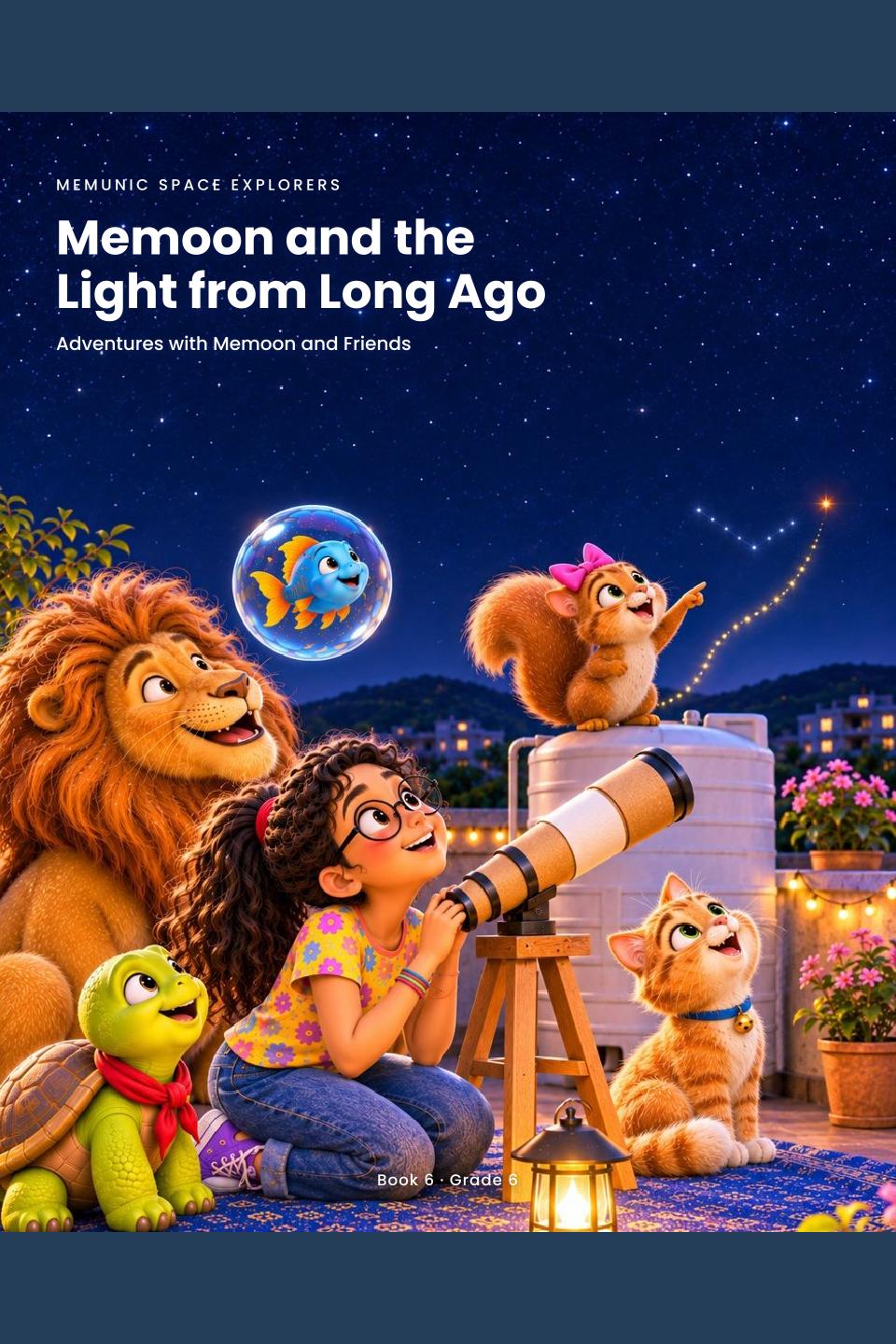
BOOK 6 OF 9 · GRADE 6 - AGES 11-12
Memoon and the Light from Long Ago
How far away is Beautine's star, and how can its light show us the past?
Secure payment by Cashfree (UPI, cards, netbanking)
- 80 PDF pages
- 9 story chapters
- Grade 6
- Ages 11-12
- Illustrated
- Quiz and answers
About this book
Beautine wants to signal her favourite orange star with a torch. It looks bright, so surely it must be nearby. Memoon and the Rooftop Sky Club discover that appearances are misleading: to find its distance, they need measurements, sky maps and the light that has travelled across space to reach them.
Nine illustrated story chapters build from a thumb-jump experiment to parallax, scale drawings, light travel time and the meaning of a light-year. The friends explore how telescopes collect light, visit the GMRT, learn about AstroSat and Gaia, and test why a darker sky reveals more stars. Their observations come together to identify Beautine's star and explain why looking far away means looking back in time.
Includes a glossary, eight-question quiz with a bonus challenge and explained answers, a Parallax Measurement project, Sky Heroes, a Mistake Museum, observing ideas and a Light Measurer badge. There is also guidance for a parent- or teacher-signed Junior Astronomer certificate after completing the required badges. The matching 69-slide classroom PDF covers all nine chapters.
How each chapter works
Illustrated chapters combine a continuing story, Science Corners, Space Detective questions, diagrams and supervised activities. Tables, calculations, graphs and competing explanations develop evidence-based reasoning, with model limits and indoor or low-resource alternatives made explicit.
What they’ll learn
- Explain why apparent brightness alone cannot tell us a star's distance.
- Measure an unreachable object's distance using a baseline, angles and a scale drawing.
- Calculate light travel times and distinguish a light-year of distance from a year of time.
- Explore telescope lenses, light gathering and the limits of simple optical models.
- Distinguish visible, infrared, radio and X-ray light, with GMRT and AstroSat examples.
- Read sky maps and explain why stars in one constellation can lie at different distances.
- Compare star counts and investigate how light pollution hides faint stars.
- Use tables, graphs, repeated measurements and competing explanations to assess evidence.
Contents
- 1How Far Is Far?
- 2Measuring Without Going
- 3Speed of Light
- 4The Light-Year
- 5Bigger Eyes
- 6Seeing the Invisible
- 7Maps of the Sky
- 8Night at the Observatory
- 9The Answer in the Light
The project: Parallax Measurement
Use two sessions of about forty-five minutes, plus a week to repeat measurements, to estimate distances to three far objects. Measure a ten- to twenty-metre baseline, take each angle three times and average it, then make scale drawings. Check one distance with an adult, graph the relationship between shift and distance, and explain errors and how a longer baseline could help. A corridor or hall provides an indoor alternative.
Who it’s for
Grade 6 children aged 11-12, with an adult sharing the calculations, diagrams, measurements and observing activities. Builds on earlier books' models and evidence, and introduces graphs, measurement error, large numbers and ratios. Indian place values appear alongside million and trillion.
What you need: An adult, a Sky Notebook, pencils, chart paper, ruler, measuring tape and a protractor or printed angle card. Selected activities use torches, lenses, cardboard tubes, beads or a calculator. Choose measurement sites away from roads and roof edges. Night observing needs an adult; stay indoors during thunderstorms. Never look at the Sun or point binoculars or a telescope anywhere near it, and keep telescope lens caps on when not in use.
Included with your purchase
- The bookThe 80-page illustrated PDF ebook
- Classroom teaching slidesMatching 69-slide PDF classroom deck covering all nine chapters and the Parallax Measurement project
Read a free sample: the first 10 pages
Can’t see the sample? Open it in a new tab.
Next in the series
Book 7: Memoon and the Search for Another Home. Is there a fish like Nimo somewhere else? The Sky Club hunts for another home with evidence.
See Book 7Ratings & reviews
No ratings yet. Be the first to rate this.
Sign in with Google to rate or review