
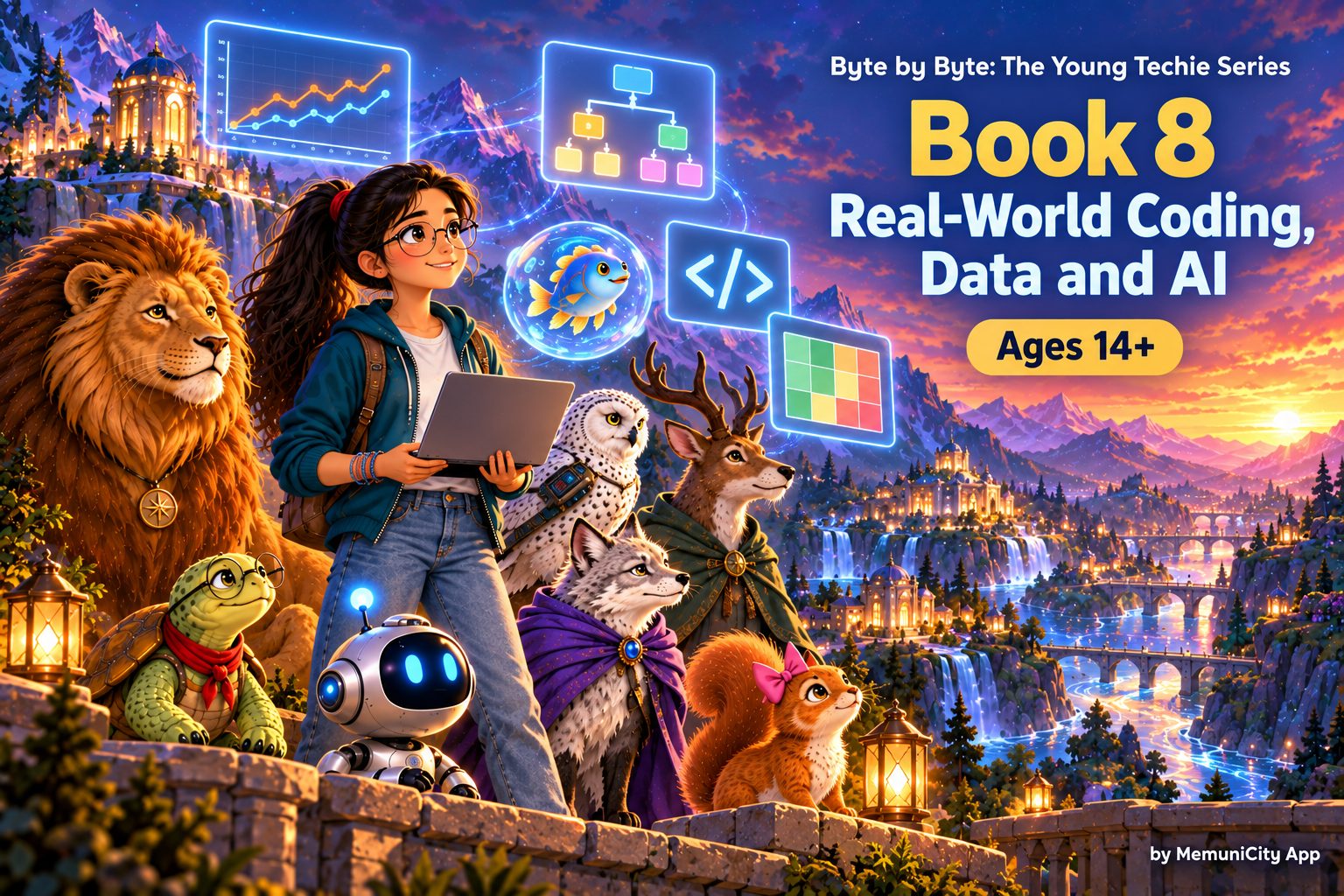
BOOK 8 OF 8 · AGES 14+ (GRADE 9)
Real-World Coding, Data and AI
The series finale - plan, code, test and prove that each fix works, the way professionals do.
Secure payment by Cashfree (UPI, cards, netbanking)
- 90 pages
- 19 chapters
- Capstone project
About this book
The whole of Memunic World gathers for the first Makers' Summit, and every friend brings a real problem. Kachui's riverbank floods without warning. Simbha's Games booking desk is chaos, and last year two families were sold the same seat. The Truth Desk is drowning in reports. The Summit's rule is simple: no magic fixes, only things that are planned, built, tested and shown to work. Memoon is fourteen now, and she no longer waits for magic. She asks what the real problem is, what data there is, and how to test whether a fix works.
Each chapter starts with a case and follows one pattern: the concepts with correct terms, Build It tasks where you type the code yourself, Test Yourself questions with a coding challenge, and Key Terms. Sidebars add Real World (how professionals use the idea), Career Spotlight and Think About It. Readers write JavaScript and make a web page interactive with the DOM and events; learn object-oriented programming in Python with a first taste of Java; save data to files and handle exceptions; clean real CSV data with pandas; use statistics (mean, median, mode, standard deviation, probability and correlation); and draw honest charts with Matplotlib.
The machine learning chapters train and test a real model, spot overfitting, and judge it with accuracy, precision, recall and a confusion matrix, so that a model that is 88% accurate can still be shown to miss flood nights. Further chapters explain how generative AI and large language models work and why they make things up, how to use AI coding assistants responsibly, and how to debug, test and use Git. The book finishes with the software development life cycle, digital citizenship, cyber law (the IT Act and the DPDP Act), tech careers and building a startup, and a capstone project.
How each chapter works
Every chapter follows the same pattern: The Case, The Concepts, Build It, Case Closed, Test Yourself and Key Terms. Answers are at the back.
What they’ll learn
- Explain compilers, interpreters, bytecode and programming paradigms
- Write JavaScript with variables, conditions, loops, arrays, objects and functions
- Make a web page interactive with the DOM and event listeners
- Write Python classes with constructors, methods and inheritance, and read simple Java
- Read and write files, and handle exceptions in Python
- Load, clean and summarise CSV data with pandas
- Calculate and interpret mean, median, mode, range, standard deviation and probability
- Choose and draw honest charts with Matplotlib
- Use absolute references, XLOOKUP, COUNTIFS, data validation and pivot tables in Excel
- Train and test a classifier, recognise overfitting, and evaluate with precision, recall and a confusion matrix
- Explain how large language models work, spot their limits, and use AI coding assistants responsibly
- Debug, test and use Git; follow the software life cycle; understand cyber law, your digital footprint and tech careers
Contents
- 1How Code Runs: Compilers, Interpreters and Paradigms
- 2JavaScript Basics: Variables, Types and Operators
- 3JavaScript Decisions, Loops and Functions
- 4The DOM and Events: Making Web Pages Interactive
- 5Object-Oriented Programming: Classes and Objects
- 6Files and Exceptions in Python
- 7Working with Real Data: CSV Files and Data Cleaning
- 8Statistics for Data and AI
- 9Charts and Data Visualisation in Python
- 10Advanced Spreadsheets: Absolute References, Lookups and Pivot Tables
- 11Training and Testing a Machine Learning Model
- 12Evaluating AI: Accuracy, Precision, Recall and the Confusion Matrix
- 13Generative AI and Large Language Models
- 14Using AI as a Coding Assistant Responsibly
- 15Debugging, Testing and Version Control with Git
- 16The Software Development Life Cycle
- 17Digital Citizenship, Cyber Law and Your Digital Footprint
- 18Careers in Technology and Building Your Own Startup
- ·Revision: Let's Remember
The project: My Memunic Solution
Bring everything in the series together. Find a real problem in your home, school or neighbourhood and solve it the way professionals do - problem, plan, code, test, present - over three to five weeks. Example problems: the school canteen runs out of popular items, classmates forget homework deadlines, the society's water tank overflows, or a local shop wants online orders. The reader interviews at least three affected people, writes a problem statement and user stories, plans the data ethically, then builds, tests and presents the solution.
Who it’s for
Teens aged 14 and up, young coders, parents and educators. Written at Grade 9 level and beyond, it covers the CBSE Class 9 Artificial Intelligence and Information Technology topics and the ICSE Class 9 Computer Applications ideas of object-oriented programming and Java. It builds on the Python, HTML and CSS from the earlier books.
What you need: A Windows 11 computer with Microsoft Edge, Notepad or VS Code, Google Colab (free, with a Google account - ask a parent) for Python, data, charts and machine learning, and Microsoft Excel or Excel for the web. An online Java compiler is used for the Java taste, and Git for Windows is optional.
Included with your purchase
- The bookThe 90-page illustrated ebook
- Teaching and classroom slidesA full lesson deck - the whole book as slides, chapter by chapter, for teaching or projecting
Read a free sample: the first 19 pages
Can’t see the sample? Open it in a new tab.
Ratings & reviews
No ratings yet. Be the first to rate this.
Sign in with Google to rate or review