
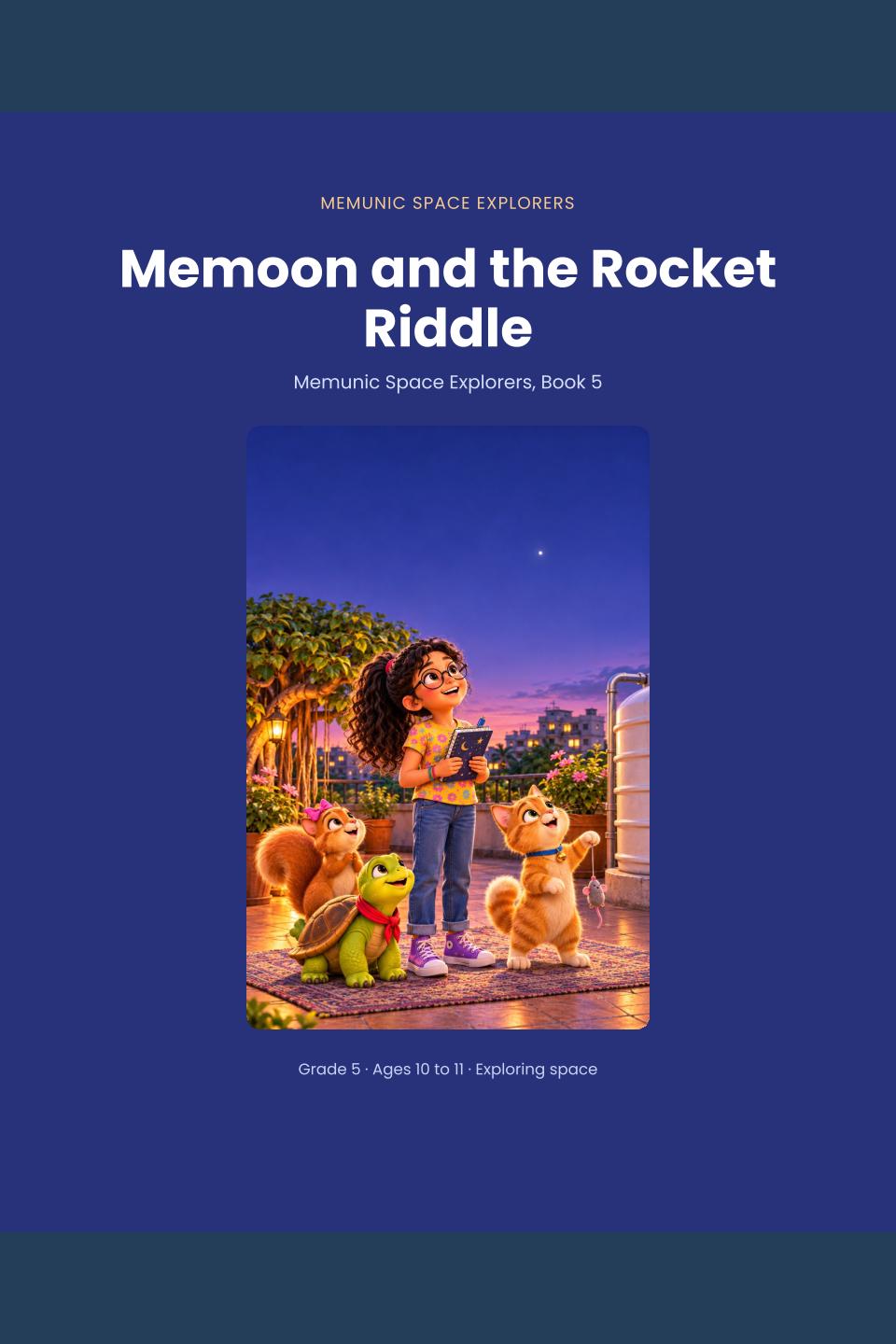
BOOK 5 OF 9 · GRADE 5 - AGES 10-11
Memoon and the Rocket Riddle
A mouse-to-the-Moon plan becomes a mission to understand gravity, rockets and life in space.
Secure payment by Cashfree (UPI, cards, netbanking)
- 64 PDF pages
- 8 story chapters
- Grade 5
- Ages 10-11
- Illustrated
- Quiz and answers
About this book
Noodles has a very big plan: send his mouse friend Chiku to the Moon with one enormous throw. Memoon and the Rooftop Sky Club test the idea with a sponge ball instead, then follow the evidence through balloon rockets, satellites, a space station and robot missions. Meanwhile, Kachui records a mysterious bright light crossing the evening sky.
Eight illustrated story chapters explain gravity, action and reaction, orbits and free fall, satellite jobs, astronaut life, robotic exploration and why sound needs a medium. Children make predictions, repeat trials, compare results in tables and investigate surprising measurements before bringing the ideas together on Mission Design Day.
Includes a glossary, eight-question quiz with a bonus challenge and explained answers, a Plan Your Own Moon Mission project, Sky Heroes, a Mistake Museum, observing ideas and a Mission Planner badge. The matching 84-slide classroom PDF covers all eight chapters, activities and supporting material.
How each chapter works
Each illustrated chapter includes a learning goal, a continuing story, Science Corner, Space Detective questions and a supervised Try It activity. Tables, repeated trials and predict-observe-explain tasks develop reasoning, with explicit distinctions between real science, models and Imagine Mode.
What they’ll learn
- Investigate gravity with timed sponge-ball tests and compare predictions with repeated trials.
- Explore action and reaction with an adult-supervised balloon rocket on a string.
- Explain an orbit as falling around Earth and why astronauts float while gravity still acts.
- Compare satellite jobs, low and geostationary orbits, and the problem of space debris.
- Discover space-station life, astronaut training and evidence for identifying a passing station.
- Explore why robots go first and how signal delays affect mission planning.
- Test how sound travels through materials and distinguish sound from radio messages.
- Design a toy Moon mission with a mass budget and three trials of a safe test.
Contents
- 1What Goes Up
- 2Push Back
- 3Falling Around the World
- 4Satellites at Work
- 5Life Aboard a Space Station
- 6Robots Go First
- 7Is Space Noisy?
- 8Mission Design Day
The project: Plan Your Own Moon Mission
Spend one to two hours over a few days making a Mission Plan Card with seven boxes: Goal, Push, Orbit, Helpers, Crew and Air, Robot First, and Messages. Choose a goal for a pretend robotic mission, make a mass budget for a toy lander, and test one safe idea three times. Record the results in a table and explain one mistake you corrected to earn a Mission Planner badge. Everything can be done indoors with paper and household items.
Who it’s for
Grade 5 children aged 10-11, with an adult sharing the experiments and discussions. Builds on observation, scientific models, Moon phases and planetary motion from earlier books. Questions use explanations, predictions, simple arithmetic and tables; every activity has an indoor or low-resource choice.
What you need: An adult, paper or card, pencils, a ruler, a timer, a sponge ball or rolled-up socks, string, a straw, tape, balloons and household items for supervised models. A kitchen scale is optional. Check for latex allergies, keep balloon pieces away from children, tie strings below shoulder height and supervise water activities. No flames, pressure, chemicals, launchers or real rockets are used. Never look at the Sun; evening observations require an adult.
Included with your purchase
- The bookThe 64-page illustrated PDF ebook
- Classroom teaching slidesMatching 84-slide PDF classroom deck covering all eight chapters and the Mission Planner project
Read a free sample: the first 10 pages
Can’t see the sample? Open it in a new tab.
Next in the series
Book 6: Memoon and the Light from Long Ago. How far away is Beautine's star, and how can its light show us the past?
See Book 6Ratings & reviews
No ratings yet. Be the first to rate this.
Sign in with Google to rate or review