
BOOK 7 OF 8 · AGES 13+ (GRADE 8)
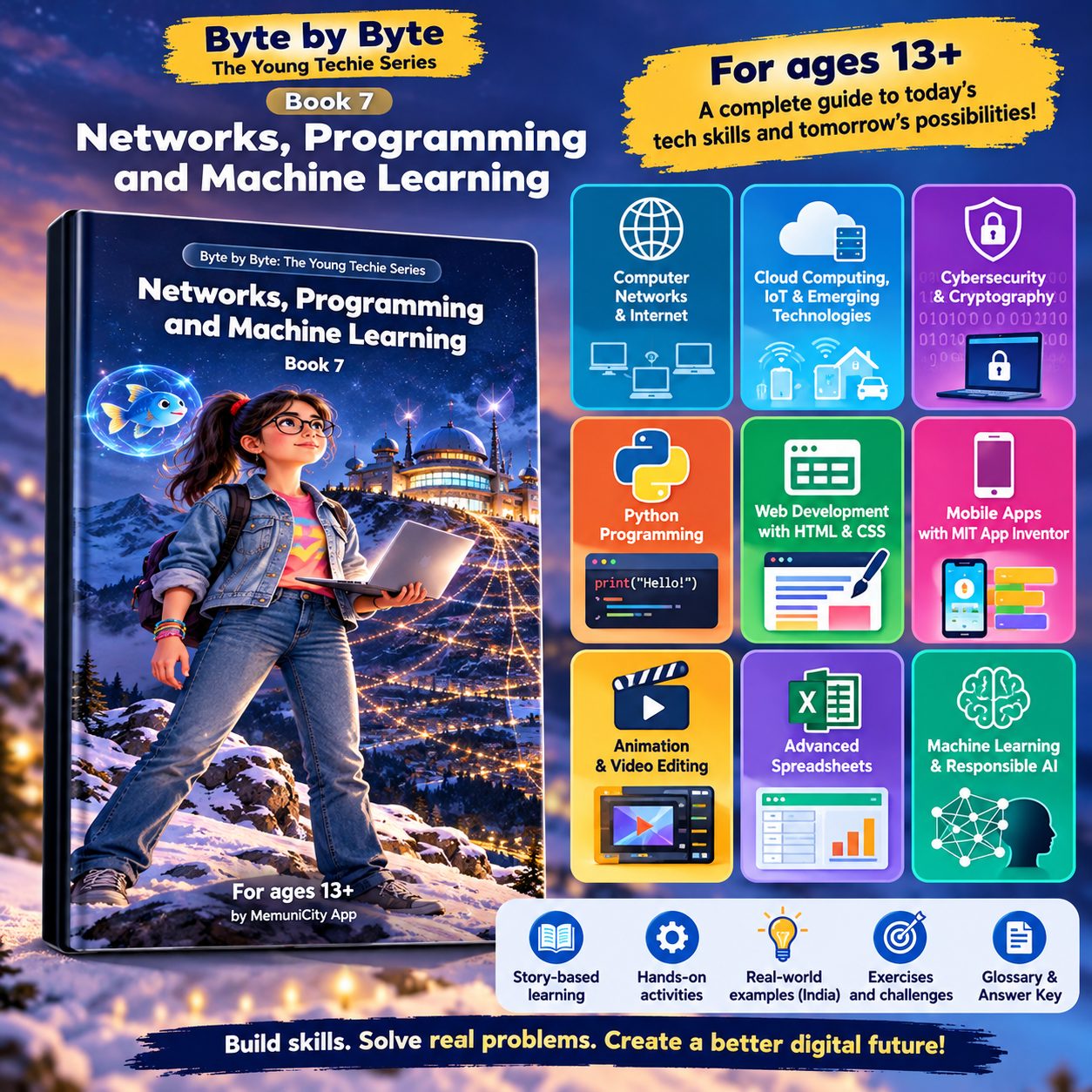
Networks, Programming and Machine Learning
From how networks carry information to building apps and judging what AI tells us.
Secure payment by Cashfree (UPI, cards, netbanking)
- 250 pages
- 17 chapters
- Mini project
About this book
At 6:42 one Sunday morning a picture appears: Simbha, Guardian of Memunic, roaring over a huddle of terrified young rabbits. By breakfast it has crossed every village. By Monday the Moonbrook rabbits are outside the palace, and the Queen asks Simbha to step aside until the truth is known. Memoon has known him since she was seven, and he has never roared at anyone. To find out what is real she has to learn how networks carry information, how to protect it and how to check it.
The book begins with how the connected world works: PAN, LAN, MAN and WAN, network topologies and devices, MAC and IP addresses, cloud computing (IaaS, PaaS and SaaS), the Internet of Things and why IoT devices are a security risk, then cryptography and cybersecurity: Caesar and Vigenere ciphers and how they are broken, public-key encryption, how HTTPS protects you, hashing and how passwords are stored, and the main cyber threats and defences.
Five chapters deepen Python with strings, lists, functions, dictionaries, top-down program design, debugging, and searching and sorting algorithms (linear and binary search; bubble, selection and insertion sort). Web design moves on to CSS, Flexbox, forms, responsive design and accessibility, and readers build a mobile app in MIT App Inventor. Creative chapters cover animation and video editing and advanced spreadsheets (nested IF, XLOOKUP, PivotTables, Goal Seek). The book ends with the AI project cycle, decision trees and neural networks, and deepfakes, misinformation and responsible AI - with methods for checking what you see before you share it.
How each chapter works
Every chapter opens with "The Case", a story problem, then teaches the concepts, sets hands-on tasks (Build It), and ends with Test Yourself questions and Key Terms. Answers are at the back.
What they’ll learn
- Explain network types and topologies, network devices, and the difference between a MAC and an IP address
- Explain cloud computing, IoT and its security risks, and emerging technologies
- Describe encryption, HTTPS, hashing and digital signatures, and defend against common cyber threats
- Program in Python with strings, lists, functions and dictionaries, and design larger programs top-down
- Trace and compare searching and sorting algorithms, and count steps to judge efficiency
- Style and lay out responsive web pages with CSS, Flexbox and forms, with accessibility in mind
- Plan and build a mobile app with MIT App Inventor
- Animate and edit video, and use advanced spreadsheet features including PivotTables
- Work through the AI project cycle, and explain decision trees, perceptrons and neural networks
- Tell misinformation from disinformation, spot deepfakes, and check sources before sharing
Contents
- 1Computer Networks and How Devices Connect
- 2Cloud Computing, IoT and Emerging Technologies
- 3Cryptography and Cybersecurity
- 4Working with Strings
- 5Python Lists
- 6Writing Your Own Functions
- 7Dictionaries and Program Design
- 8Searching, Sorting and Efficiency
- 9Styling Web Pages with CSS
- 10Page Layout, Forms and Responsive Design
- 11Building Mobile Apps with MIT App Inventor
- 12Animation and Video Editing
- 13Advanced Spreadsheets
- 14The AI Project Cycle
- 15Decision Trees and Neural Networks
- 16Deepfakes, Misinformation and Responsible AI
- ·Revision: Let's Remember
The project: My Truth Desk
The Queen asks every village to set up its own Truth Desk. The reader builds one for their own school or community: a place where people can check whether something they have heard is true before they share it. There are three required parts and two optional extras. The reader plans with a problem canvas, talks to at least three people about rumours they have seen, and keeps a project log of what they did, what went wrong and how they fixed it.
Who it’s for
Students aged 13 and up (Grade 8 skills), young coding enthusiasts, parents and educators. It opens with a recap of Book 6 and builds on its Python, HTML and AI foundations. It supports Class 8 computer courses, and includes revision, a glossary and an answer key for self-study.
What you need: A computer with Python and IDLE, a web browser and Notepad, plus Excel, MIT App Inventor and a video editor for the optional chapters.
Included with your purchase
- The bookThe 250-page illustrated ebook
- Teaching and classroom slidesA full lesson deck - the whole book as slides, chapter by chapter, for teaching or projecting
Read a free sample: the first 20 pages
Can’t see the sample? Open it in a new tab.
Next in the series
Book 8: Real-World Coding, Data and AI. The series finale - plan, code, test and prove that each fix works, the way professionals do.
See Book 8Ratings & reviews
No ratings yet. Be the first to rate this.
Sign in with Google to rate or review