
Your Listing Is Not Enough: How to Actually Get Customers From It
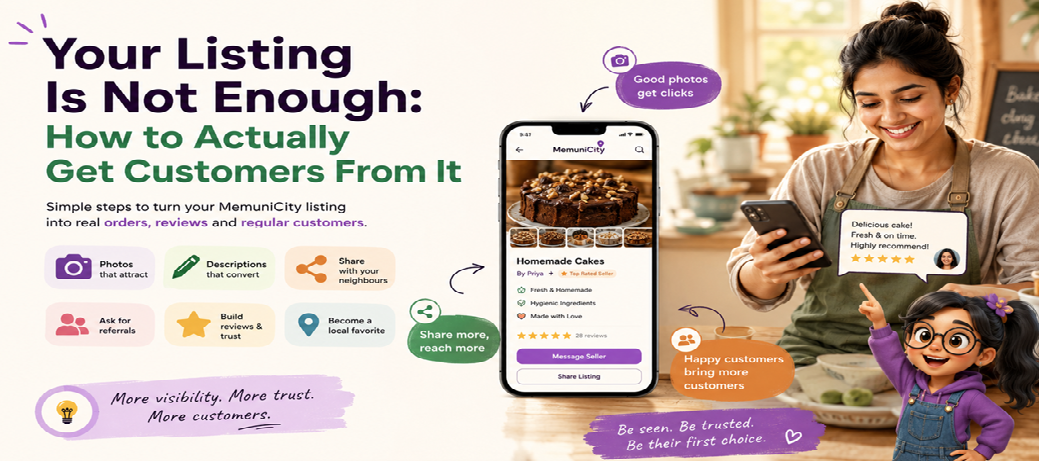
You did it. You photographed your brownies, filled in the price, wrote a description, and hit publish. Your listing is live on MemuniCity.
Now here is the uncomfortable truth that almost nobody tells first-time sellers: a published listing is not a marketing plan. It is a shop with the lights on and the door open — on a street nobody has walked down yet.
The sellers who get 10, 20, 50 orders in their first month are not lucky, and they are usually not the ones with the best product. They are the ones who treat the listing as step one of five, not the finish line.
This article is the missing four steps. Everything here is specific, doable this week, and costs you nothing except a little deliberate effort.
The Math Nobody Shows You
Before the tactics, understand the funnel. Every sale on a neighbourhood marketplace follows roughly the same path:
People who see your listing → People who open it → People who trust it → People who buy → People who tell others
Most new sellers obsess over the middle (the listing itself) and completely ignore the two ends — visibility and word of mouth. But the ends are where the leverage is:
- If 20 people see your listing and 10% buy, you get 2 orders.
- If 200 people see the same listing and 10% buy, you get 20 orders.
Same product. Same photos. Same price. 10x the result — purely from distribution. So let's fix the whole funnel, in order.
Step 1: Make the Listing Worth Opening (Photos)
People scroll fast. Your photo has about one second to earn a tap. Research on online marketplaces consistently finds that listings with clear, well-lit photos get 2–3x more engagement than the same product shot badly. Here is the practical version of that research:
The 5 rules of a photo that sells:
- Daylight, always. Shoot near a window in the morning. Yellow tube-light photos make even great food look like leftovers. No lamp beats the sun — and it's free.
- Plain background. A clean plate on a plain table. A saree on a bedsheet-free, clutter-free surface. The product should be the only thing in the frame. Your kitchen counter's mixer-grinder does not need a cameo.
- Fill the frame. The product should occupy 70–80% of the photo. If a buyer has to zoom in to see what you're selling, you've already lost them.
- Show scale and context. One close-up, one photo with something familiar for size (a hand holding the jar, the cake next to a teacup), and one "in use" shot if it's a service or a used item.
- Show honesty for used items. Selling a pre-loved toy or book? Photograph the wear, don't hide it. A buyer who sees the scratch before buying leaves a 5-star review. A buyer who discovers it after leaves a complaint. Honest photos are not a weakness — they are your review insurance.
Do this today: Re-shoot your main photo in daylight against a plain background. This single change outperforms almost everything else in this article per minute of effort spent.
Step 2: Write a Description That Converts (Not One That Describes)
Most descriptions read like an inventory label: "Chocolate brownies. 6 pieces. ₹250."
That describes. It doesn't convert. A converting description answers the three questions every buyer silently asks:
Question 1: "Is this for me?" — Open with the person, not the product.
❌ "Homemade chocolate brownies, 6 pieces." ✅ "Fudgy, homemade brownies — perfect for the 6 pm chai break or a last-minute birthday fix. Baked fresh the morning of your order."
Question 2: "Can I trust this?" — Add the specifics only a real person would know.
"I use Amul butter and Callebaut chocolate — no premixes. Baking from my kitchen in this society for 3 years."
Specifics are the currency of trust. "Good quality" is a claim; "Callebaut chocolate, no premix" is evidence.
Question 3: "What happens after I click buy?" — Remove the last-moment hesitation.
"Order by 12 pm, pick up from B-block by 6 pm same day. I'll message you when it's ready."
The formula, in one line: Who it's for → why it's trustworthy → what happens next. Three short paragraphs. No essay needed. If your description takes longer to read than your product takes to eat, trim it.
Step 3: Share It Like You Mean It (This Is Where Most Sellers Fail)
Here is MemuniCity's most underused feature: every listing has a public link that anyone can open — no login, no app, no sign-up needed to view it. Someone taps your link, sees your photos, your price, your reviews. That link is your shop's front door, and you can put that door anywhere.
Yet most sellers share their listing exactly once, in one group, and then wait. Waiting is not a strategy. Here is one:
The Week-One Sharing Plan:
- Day 1 — Your society's WhatsApp group. Not just the link. Write two warm lines first: "Hi neighbours! I've started taking orders for homemade brownies — baked fresh, same-day pickup from B-block. Would love for you to try them 🙂" — then the link. A bare link looks like spam; a bare link with a human hello looks like a neighbour.
- Day 2 — Your personal WhatsApp status. Your contacts include dozens of people in and around your society who never open group chats. Status gets seen by the silent majority.
- Day 3 — Direct messages to 5 likely buyers. The neighbour who asked about your baking at the society Diwali event. The parent from the school pickup point. Personal beats broadcast, every time: "Hey! Remember you asked about my brownies? I've listed them now — here's the link if you'd like to order."
- Day 5 — Ask one friend to forward it. A recommendation from a third person is worth ten self-promotions. "If you liked them, would you mind forwarding this to your building's group?"
- Day 7 — Share again, differently. New photo, new angle: "First weekend of orders done — thank you! Taking orders for next week now." Sharing progress is not repetition; it's proof.
The mindset shift: you are not "promoting yourself." You are telling neighbours that something useful now exists two buildings away. That is information they actually want. The awkwardness you feel is far bigger in your head than in theirs.
Step 4: Turn Every Buyer Into Two More (Referrals)
Word of mouth is the entire growth engine of neighbourhood commerce — but here's what the research on referrals consistently shows: satisfied customers rarely refer on their own. They refer when asked, at the right moment.
The right moment is the peak of their happiness with you — right after a great delivery, a compliment, a repeat order. Not a week later. Not in a mass message.
The ask, scripted:
"So glad you liked it! Small request — I'm just getting started here, and it would mean a lot if you shared my listing with anyone in the society who might enjoy these. Here's the link 🙂"
That's it. No discount codes, no schemes. In a society, a referral is one forward in a family WhatsApp group — the cost to your customer is ten seconds, and the credibility to the new buyer is enormous, because it arrived from someone they know, about a seller who lives right there.
Make it effortless: whenever someone compliments your product — in person, in the lift, in a group — reply with thanks and the link. A compliment is a referral that hasn't been forwarded yet. Your job is just to hand them something forwardable.
Step 5: Build a Review Base Before You "Need" It
Reviews are what your listing looks like to a stranger. When someone who has never met you opens your link, your photos make the promise — your reviews prove somebody checked.
Marketplace data across platforms is remarkably consistent on this: the biggest trust jump happens between zero reviews and the first few. Going from 0 → 3 reviews changes you from "unknown" to "established" in a stranger's mind. Going from 30 → 33 changes almost nothing. So your first weeks are precisely when reviews matter most — and when sellers ask for them least.
How to actually get those first reviews:
- Ask every single early buyer, personally. Right after delivery, when the experience is fresh: "If you have a minute, a quick review on my listing would really help me get started — it makes a big difference for a new seller."
- Make it specific. "Please review" gets ignored. "A quick line about how the brownies tasted would really help" gets written.
- Never trade for reviews. No "review and get a discount." Neighbours talk; your reputation in a society is one bad shortcut away from gone. Ask honestly, accept whatever comes.
- Respond to what you get. A thank-you reply on a review shows every future reader that a real, attentive person runs this shop. And if a review is critical — respond graciously and fix the issue. A well-handled complaint convinces more strangers than a five-star rave, because it shows how you behave when things go wrong.
The One-Week Checklist
Everything above, compressed. Print it, tick it:
- Day 1: Re-shoot main photo — daylight, plain background, product fills the frame
- Day 1: Rewrite description — who it's for → why trust it → what happens next
- Day 1: Share in society group with a warm two-line intro
- Day 2: Post on WhatsApp status
- Day 3: DM 5 people who've shown interest before
- Day 5: Ask one happy contact to forward your link
- Every delivery: Ask for a review, personally and specifically
- Every compliment: Reply with thanks + your listing link
- Day 7: Share an update — orders done, what's next
The Real Point
Your neighbours already prefer buying from you. Someone two buildings away, whose face they know, who they can talk to in the lift — that beats an anonymous app warehouse on trust, freshness, and accountability every single time.
The only thing standing between your listing and their order is that they don't know it exists yet.
The listing was step one. You now have the other four. The sellers who thrive on MemuniCity aren't the ones with the fanciest products — they're the ones who shared one more time, asked one more neighbour, and collected one more review while everyone else was waiting to be discovered.
Don't wait to be discovered. Be impossible to miss.
Got your listing live? Start with Step 1 today — one daylight photo. Everything else follows.
Comments
Sign in to comment.
No comments yet.