
The One-Page Business Plan Every Home Business Needs
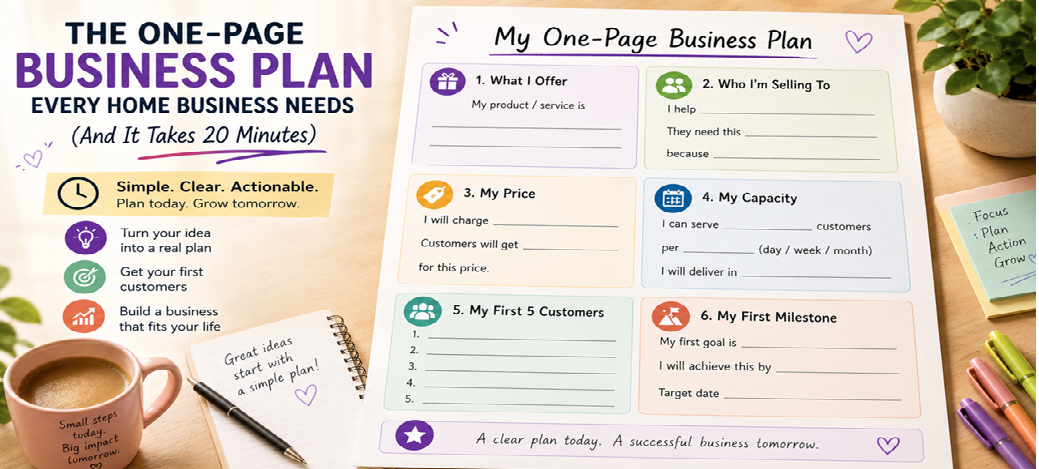
A fill-in-the-blank framework: what I offer, who I'm selling to, my price, my capacity, my first 5 customers, my first milestone.
Somewhere along the way, "business plan" stopped meaning a plan and started meaning a document you write for someone else — a bank, an investor, a competition judge. That document is real and occasionally useful. It is also not what you need on a Tuesday night at your kitchen table trying to decide whether to actually start selling the sourdough, the soap, the spreadsheets-for-freelancers service, or the dog-walking round you've been talking about since spring.
What you need at that stage isn't a pitch. It's a diagnostic — something that forces the idea out of your head, where it feels both perfect and terrifying, and onto paper, where it becomes ordinary and checkable. A one-page plan does that in the time it takes to reheat dinner. Not because the questions are shallow, but because they're the only six that matter before you've made a single sale.
- 1 page. Not a slide deck.
- 6 blanks to fill in, in order.
- ~20 minutes for a first honest draft.
01 — Why the 40-page plan fails home businesses specifically
Formal business plans were built for a scenario most home businesses don't have: a stranger with money who needs to be convinced. If you're not raising a bank loan or investor round this month, you're writing a document to persuade an audience of one — future-you, three months from now, wondering why you got busy but not profitable.
Long plans also invite a specific failure mode: research as procrastination. Market-sizing spreadsheets and five-year projections feel like progress because they're effortful, but effort isn't the same as movement toward a paying customer. A one-page plan is short on purpose — short enough that finishing it obligates you to start, not to keep planning.
The plan isn't the product. The plan is what tells you, in twenty minutes, whether the product is worth a weekend.
02 — The six blanks, and why each one is load-bearing
Every home business — candles, coaching, catering, code — collapses into the same six decisions. Skip one and the idea stays a feeling instead of becoming a plan. Here's what each blank is actually testing, before you see the sheet itself:
1. What I offer
Not your whole catalogue — the one thing a stranger could understand in a sentence. "I make small-batch hot sauce in three heat levels" beats "I'm passionate about flavor and fermentation." Specificity here is what makes everything downstream answerable.
2. Who I'm selling to
Not "everyone who likes good food." A person, a situation, a reason they're buying today. Vague audiences produce vague marketing; a named audience tells you exactly where to find your first ten customers.
3. My price
The number you'd actually charge if someone asked right now — not "I'll figure out pricing later." A price forces you to confront your costs, your time, and whether the math works before you've built anything around it.
4. My capacity
How many units, hours, or clients you can genuinely deliver on in a week without your day job or your family noticing something's wrong. This is the blank most home businesses skip, and the one that causes burnout by month two.
5. My first 5 customers
Not a marketing funnel — five actual names, or five specific places those names live (a WhatsApp group, a school gate, a subreddit, a street). If you can't name five people who might plausibly buy, the idea isn't ready for a plan; it's ready for more conversations.
6. My first milestone
One number, one date. "₹15,000 in sales by the 15th" or "10 paying customers by end of month." A milestone converts "I'm starting a business" — which never finishes — into "I'm hitting a target," which either happens or teaches you something by a fixed deadline.
03 — The sheet itself
Copy this structure onto an actual sheet of paper, a sticky note, or a blank doc. Fill in the blanks in order — each one gets easier once the last one is answered honestly. Don't edit as you go; a rough true answer beats a polished vague one.
THE ONE-PAGE PLAN                                    draft 1

WHAT I OFFER
One sentence. What is it, and what makes it specific?
I offer ________________________________________________

WHO I'M SELLING TO
A person and a situation, not a demographic.
to ____________________________, who needs it because __________________

MY PRICE
The number, today. Round is fine.
at ₹ __________ per _______________

MY CAPACITY
The honest weekly ceiling, given everything else on your plate.
I can deliver __________ per week without it costing me my job / sleep / sanity

MY FIRST 5 CUSTOMERS
Names, or exactly where to find them.
1. _______  2. _______  3. _______  4. _______  5. _______

MY FIRST MILESTONE
One number, one date. No range.
By ____________ (date), I will have __________________ (result)
04 — Filling it in: twenty minutes, in order
The order matters more than the content. Each blank narrows the next one, so working top to bottom turns a vague idea into a specific, checkable plan without you noticing the narrowing happen.
TimeStep0:00 – 0:03Write the offer as if explaining it to a neighbor. No adjectives about passion or quality. What is the thing, literally.0:03 – 0:07Name the buyer, not the market. If you write "busy parents," stop and narrow it to one busy parent you actually know.0:07 – 0:10Set a price you'd say out loud today. You will change it later. That's fine — a placeholder price still tells you if the model works.0:10 – 0:13Cap your weekly capacity honestly. Multiply price × capacity. That's your real ceiling this month — look at it before you get attached to a bigger number.0:13 – 0:18List five real names. If you get stuck before five, that's information — it means step 2 was too vague. Go back and re-narrow the buyer.0:18 – 0:20Pick one milestone and one date. Set it slightly uncomfortable. A milestone you're certain to hit isn't doing its job.Why order beats content: A vague offer produces a vague buyer, which produces an unanswerable price, which makes capacity meaningless, which makes five names impossible to find. Fix problems at the earliest blank where they appear — don't patch a bad milestone when the real issue is blank one.
05 — Research to do before you fill in each blank
The one-page plan is fast because it assumes you already know a few things. If you don't, that's not a reason to skip the sheet — it's a same-evening research list, each item mapped to the blank it unlocks.
-
→ Unlocks: What I offer — Search your specific offer plus your city or neighborhood on Instagram, Facebook Marketplace, and a local WhatsApp/community group. Three competitors doing something close is a good sign — it means demand exists. Zero results is not proof of opportunity; it's often proof no one else thought it was worth doing at this price.
-
→ Unlocks: Who I'm selling to — Find where your named buyer already gathers online or offline — a residents' WhatsApp group, a subreddit, a school parents' list, a local Facebook group. You're not researching demographics; you're finding the room you'll eventually knock on.
-
→ Unlocks: My price — Price-check three direct competitors and one adjacent alternative (the DIY option, or the nearest substitute). Then work backward from your real costs — ingredients, materials, platform fees, your time at a rate you'd actually accept — to find the floor below which you lose money.
-
→ Unlocks: My capacity — Time yourself doing one real unit of the work — one batch, one client hour, one delivery run — including the invisible parts (packaging, travel, cleanup, admin). Most capacity estimates fail because they only count the visible half of the job.
-
→ Unlocks: My first 5 customers — Look for any past evidence of demand you already have and have been ignoring — people who've asked you for this before, complimented a gift you made, or asked "do you sell these?" That question, asked unprompted, is the single best research signal a home business can get.
-
→ Unlocks: My first milestone — Check what similar-scale sellers near you seem to be doing in their first month — order counts on a marketplace listing, review dates, visible activity. You're not benchmarking to copy; you're calibrating so your milestone is uncomfortable but not fantasy.
06 — What to do with it once it's filled in
A one-page plan isn't a keepsake. Treat it as a living instrument with two uses:
- Before you start: read it back and ask which blank you're least sure of. That's your actual risk — not "will people like it," but the specific unanswered question underneath it.
- After your milestone date: compare result to target. Missed it? Don't rewrite the whole plan — find the single blank that was wrong (usually the buyer or the price) and redo the page from there down.
Revisit it monthly, not daily. A plan you touch too often turns into anxiety; a plan you never touch turns into fiction. Once a month, on the same day your milestone lands, is the right cadence for a business still finding its shape.
The honest version: This sheet won't tell you if your idea is good. It will tell you, in twenty minutes, whether you understand it well enough to find out — and that's the only thing standing between "someday" and a first sale.
Field Notes — Home Business Series · Print it, pin it, fill it in tonight.
Comments
Sign in to comment.
No comments yet.