
Why Your Colony Is Your First Market (And How to Treat It That Way)
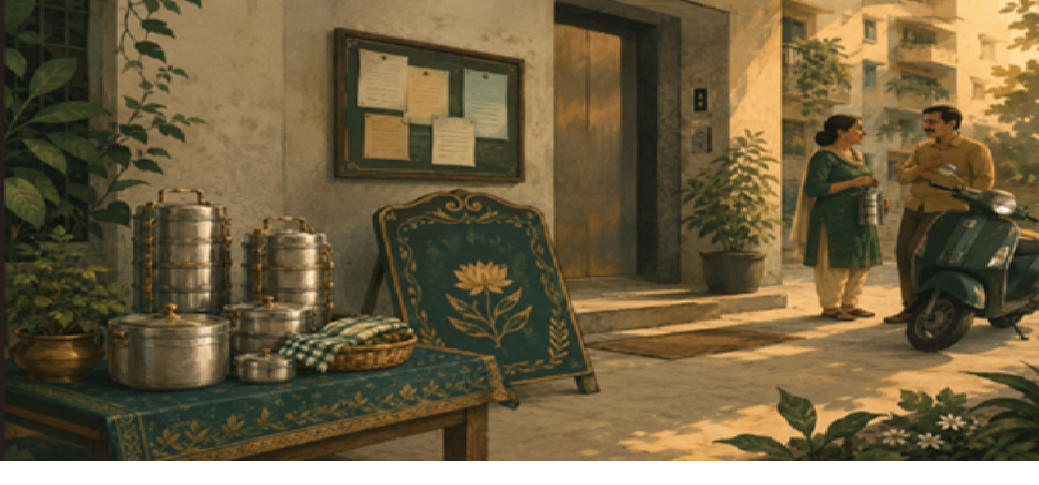
Proximity builds trust faster than any advertisement ever will. Here's how to read your own street like a market — and why starting small is the advantage, not the limitation.
The best-selling tiffin service in most Indian colonies didn't win with a menu, a logo, or a food-delivery-app listing. It won because the aunty two floors up tried it first, said something to the WhatsApp group, and by Thursday four flats on the same wing were subscribed. No funnel. No ad spend. Just a hundred metres of hallway doing what a marketing budget cannot.
That hundred metres is not a limitation on the business. It is the business. Before a seller ever thinks about scale, they should understand that the society, street, or block they already stand in is a fully formed market — with its own demand, its own distribution, and its own trust economy — and it rewards a completely different kind of thinking than the one most first-time sellers arrive with.
Trust Travels at Walking Speed
An advertisement asks a stranger to believe a claim. A neighbour asking to borrow your umbrella already knows where you live. That single fact — that you are locatable, seeable, and answerable to the same gate guard — does more for credibility than any five-star rating ever could. Trust in a hyperlocal market isn't earned through messaging; it's inherited from proximity itself.
This is why a home baker in a 40-flat society can out-convert a well-funded delivery app for the exact same category of product. The app is optimising for reach. The baker is operating inside a pool of people who already share a lift, a parking lot, and a festival WhatsApp group with her. Every one of those shared touchpoints is a small deposit into a trust account that a stranger-facing ad simply has no way to open.
An ad interrupts a stranger. A colony introduces a neighbour. One is a transaction you have to justify; the other is a relationship you only have to maintain.
The practical implication is that a seller's very first customers should never be treated as a randomly acquired sample — they are a hand-picked reference group who will vouch for you to the next twenty people, at no cost, because vouching for a neighbour costs them nothing but a sentence.
The Market Is Smaller Than You Think, and That's the Point
Most new sellers try to picture their market the way a national brand would — a whole city, an age bracket, a demographic slice. That map is too big to act on and too abstract to trust. The useful map is physical and small: which gate, which wing, which fifteen-minute walk actually contains the people who will buy from you first.
Mapping it takes an afternoon, not a research budget. Walk the block you already live or sell in and note three things: who is already gathering (the society WhatsApp group, the morning-walk cluster, the school-gate wait, the building's festival committee), who is already spending on adjacent needs (the existing tiffin walla, the newspaper vendor, the society's approved electrician), and where the natural chokepoints are — the lift lobby noticeboard, the entrance gate, the spot every resident passes twice a day.
That short list is your go-to-market plan. It tells you where to leave a sample, whom to ask first, and which existing trust network to plug into rather than build from zero. A seller who has mapped their own fifteen-minute radius this precisely will always outperform one who has only mapped a target demographic on a slide.
Field checklist — map your block:
- Walk the radius. Trace the actual paths people take — gate to lift, lift to parking, parking to market — not a circle on a map.
- Find where people already gather. WhatsApp groups, the morning walk, the school pickup line, the society committee.
- List who's already earning trust nearby. The approved electrician, the regular tiffin walla, the vendor with a standing stall — their trust is a map of what's transferable.
- Pick your chokepoint. The one noticeboard, gate, or lobby every resident passes without fail.
- Give your first ten customers a reason to talk. Not a discount — a genuinely good first experience they'd mention unprompted.
Small Isn't a Phase. It's a Moat.
Founders are trained to think of a small, local start as a stepping stone to something bigger — a validation exercise before the real market. That framing undersells what's actually happening. A hyperlocal seller operating inside one colony has three advantages a citywide competitor structurally cannot buy: feedback that arrives in hours instead of weeks, delivery costs that round to zero because the customer is a five-minute walk away, and a reputation that compounds inside a closed network instead of evaporating into a general feed.
A citywide seller hears about a bad batch of samosas from a support ticket, three days late, stripped of context. A colony seller hears about it from the customer directly, that evening, in enough detail to fix tomorrow's batch before it ships. That speed of correction is not a nice-to-have — it is a compounding quality advantage that shows up as loyalty long before it shows up as revenue.
Scale dilutes feedback. Proximity concentrates it. A seller who starts micro isn't waiting to grow up — they're operating with a signal quality that growth will later cost them.
This is also why starting small is a defensible position, not a temporary one. A large competitor can undercut on price, but it cannot manufacture the fact that your customer's child studies with your child, or that you were the one who helped when the lift broke down. Those are not marketing assets — they are structural ones, and they only exist at the scale of a street.
The instinct to "think bigger" is usually right for a five-year plan and wrong for a first ninety days. Before a seller worries about reach, they should treat the hundred metres around them as the real market it already is — map it honestly, earn the first ten neighbours properly, and let proximity do the selling that no advertisement was ever going to do as well.
Comments
Sign in to comment.
No comments yet.