
Why the Society WhatsApp Group Is a Terrible Marketplace
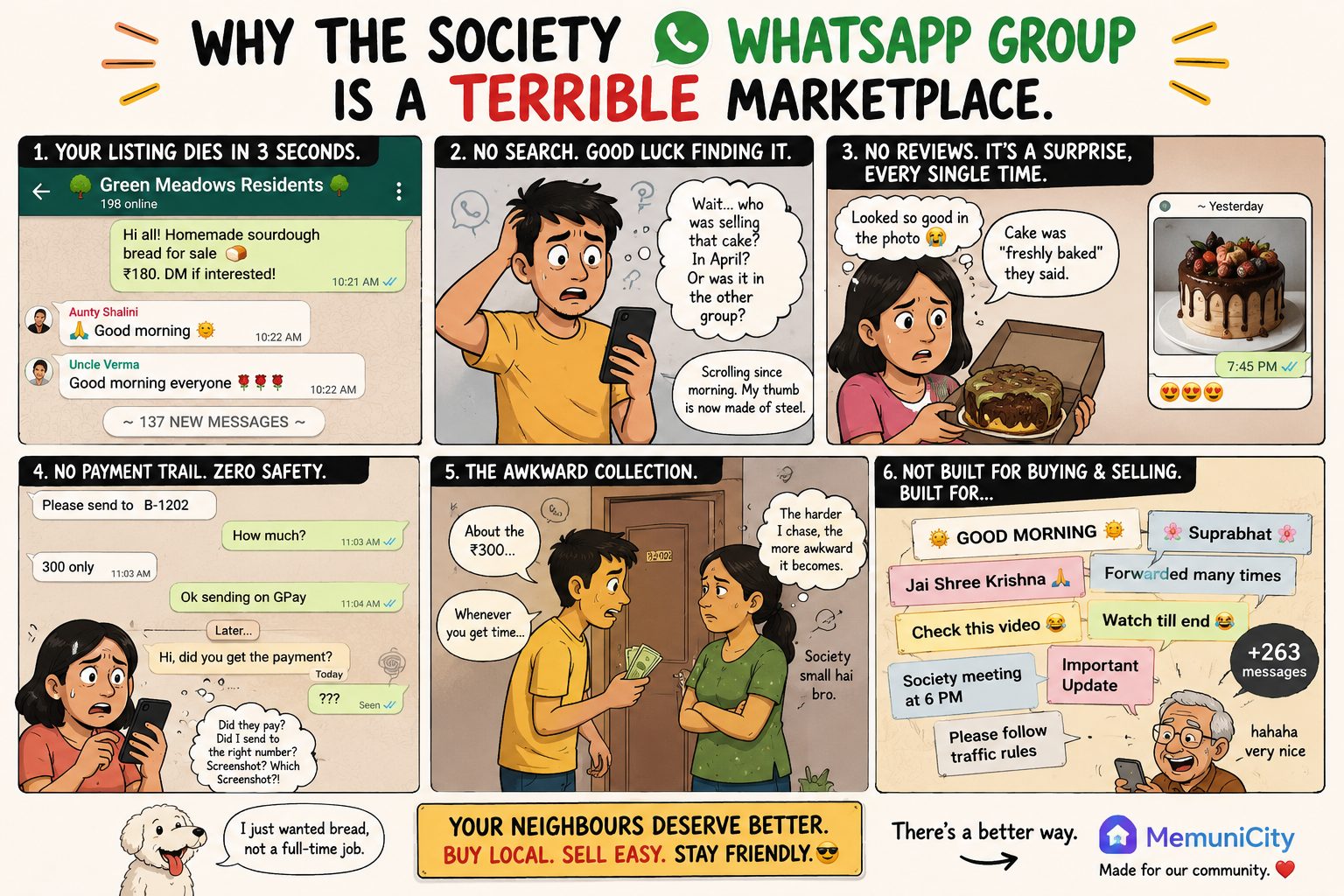
And why we all keep using it anyway.
Let me start by saying the society WhatsApp group is a marvel of human coordination.
Water tanker is late? Group. Lift stuck between the 4th and 5th? Group. Someone's Maruti parked across two slots at an angle that suggests they left the car in a hurry to attend a personal emergency? Group, with photo, with number plate zoomed in, with three fire emojis.
For emergencies, gossip, and passive-aggressive parking diplomacy, it is undefeated.
As a marketplace, it is a disaster. And I think we've collectively agreed not to talk about it.
Exhibit A: the 200 good-mornings
Here is a real sequence of events that happens in every apartment in Bangalore, at least twice a week.
7:12 AM — Someone posts a sunrise with "Good Morning 🌸🙏🌸" in a font that appears to have been rendered on a Nokia 3310.
7:14 AM — Eleven people respond with different flowers.
7:31 AM — Someone forwards a message about a plant that cures nine diseases.
8:02 AM — Neha from B-block posts: "Hi all, I bake sourdough on weekends. Whole wheat + jalapeño cheddar this Saturday. ₹350. DM if interested 🙂"
8:03 AM — "Good morning all 🌻"
8:04 AM — "Testing"
8:05 AM — Someone asks if anyone has seen a grey cat.
8:06 AM — Cat found.
8:07 AM — Twelve congratulatory messages about the cat.
By 9 AM, Neha's sourdough is four hundred messages up the scroll, entombed under a landslide of marigolds. By Saturday, three people order. She baked for eight.
This is not a Neha problem. Neha did everything right. The group simply has no concept of importance. To WhatsApp, a bread announcement and a good-morning rose are the same object with the same weight, competing on the only axis the group understands: recency.
Which means selling in a WhatsApp group is a job. The job is: post again at 6 PM. Post again tomorrow. Post again on Friday and apologise for reposting. And the moment you apologise for reposting, you have understood something dark about the medium — you're not sharing, you're advertising, and everyone can smell it.
Exhibit B: search does not exist
Three months ago, someone in your group offered maths tuition for 9th standard. You remember it. You remember the message was long. You remember there was a photo of a whiteboard.
You do not remember the person's name.
So you scroll. You scroll past the Diwali wishes, past the AGM notice, past the 40-message argument about whether the clubhouse should allow birthday parties. You give up somewhere around Onam and type the thing everyone eventually types:
"Sorry to disturb, someone had shared a maths tuition contact some time back, could you please share again? 🙏"
Nobody responds. Not because they're rude, but because everyone who saw it thinks someone else will answer.
The information was there. Right there. In your pocket. It just isn't findable, because a chat thread is a river, not a library. WhatsApp search will happily find "maths" in 60 different messages, 59 of which are your friend complaining about their kid's maths teacher.
Exhibit C: reputation is entirely vibes-based
In the group, a seller's credibility rests on one of two things: whether someone in the group has already used them, or whether their profile photo looks trustworthy.
That's it. That's the review system.
There is no "23 orders, 4.8 stars." There is only Anitha aunty saying "yes yes very good" — which is either the most reliable signal in Bangalore or means Anitha aunty ordered once, in 2022, and doesn't want to be impolite.
And critically: good sellers can't accumulate anything. A home baker who has flawlessly delivered 60 cakes over two years has exactly as much visible credibility as someone announcing their first attempt at a business today. All that hard-won trust lives scattered in DMs and in the memories of individual neighbours. It doesn't compound. It doesn't travel to the new family in D-block who just moved in and would love to know who to order from.
Every seller starts from zero, forever.
Exhibit D: the ₹300 problem
This is the one that hurts.
You bought something from your neighbour. Homemade ghee, a used cycle, a plant, tuition for two weeks. There was a number involved. Let's say ₹300.
Now, one of three things happened:
- You paid immediately and everything is fine. (Congratulations, you are a rare and beautiful person.)
- You said "I'll transfer, sending now" and then your kid needed something, and now it is nine days later.
- You did transfer, but you're not sure they noticed, and they're not sure you sent it, and one of you is now hunting for a screenshot from a Thursday.
Whichever branch you're on, you are about to face the single most awkward micro-interaction in Indian apartment life: chasing a neighbour for ₹300.
There's no good way to do it. "Hi, hope you're doing well!" is too soft. "Payment pending" is an accounting department. A UPI request notification is basically a slap with a glove. Meanwhile, the person you need to chase is going to be standing behind you at the lift tomorrow morning, and you will both make small talk about the weather while ₹300 hangs in the air between you like a ghost.
So you don't chase. You write it off. And a small piece of you decides never to sell to a neighbour again.
The group has no order record, no receipt, no status, no "paid on 14 March." Just two humans, one number, and a shared elevator.
Exhibit E: proximity turns every transaction permanent
Here's the structural thing that makes all of the above worse.
On any normal marketplace, a bad transaction ends. You leave a review, you feel briefly powerful, you never think about the seller again.
In your society, the seller lives 40 feet away. Their kids play with your kids. They're on the cultural committee. You will see them at Ganesha Chaturthi, at the New Year's event, at the 6:45 AM walking track for the rest of your natural life.
This makes neighbours extremely nice to each other — and completely unable to say normal transactional things. Nobody sends a follow-up. Nobody says "actually the fit was wrong, can I return it." Nobody negotiates. Nobody complains. Everybody says "no no it's fine!" and quietly stops ordering.
Proximity should make commerce easier. In a WhatsApp group, it makes it unspeakable.
The people this hurts most aren't the buyers
We frame this as a mild inconvenience — a few missed cakes, a tuition number lost to the scroll. It isn't, for one group of people.
Think about who is actually selling in these groups. Overwhelmingly, it's people running something small out of their home: a woman who bakes, a retired engineer who tutors physics, someone who does mehendi, someone who set up a tiny tiffin service after a job ended, someone who grows and sells saplings on their balcony.
These are real businesses. Small, but real. Rent-paying, school-fee-paying real.
And their entire distribution channel is a chat thread where their livelihood competes with a flower GIF and loses. Where they cannot build a reputation. Where they can't take a clean payment. Where the polite thing to do is to post about their own business as little as possible.
That's not a marketplace. That's a group chat that we've asked to be a marketplace because there was nothing else nearby.
What "not terrible" would actually look like
You don't need much. Genuinely. The bar is low:
- A listing that stays put. Something with a photo, a price, and an availability status that doesn't get buried by good mornings. It's Tuesday and Neha's sourdough is still Neha's sourdough.
- Search. "Maths tuition." Enter. Done. No apologising for disturbing anyone.
- Ratings that accumulate. So sixty perfect cake deliveries mean something to the family that moved in last week.
- A payment trail. Not because your neighbour is a fraudster — they aren't — but because a record means neither of you has to remember. And nobody has to bring up ₹300 at the lift.
- A boundary. A place where "how much?" is a normal question and not a small social rupture, because the context is commerce, not community.
None of this is technically hard. Neighbourhood-specific platforms have been quietly building exactly this — MemuniCity works society-by-society across Bangalore, with verified sellers and payments that leave a receipt, which is really all any of this needs to be. But the tool matters less than the shift in behaviour. The shift is: stop asking one chat thread to be everything.
Keep the group. Just stop selling in it.
I want to be clear that I'm not anti-group. The society WhatsApp group is a genuine civic institution and I would defend it in court.
Keep it for water tankers. Keep it for lost cats. Keep it for the parking wars, the AGM drama, the 4 AM forwards, the good mornings — yes, even the good mornings, because a hundred people wishing each other well every day is honestly quite nice when you stop resenting it.
Just stop asking it to handle money.
Because the group's real superpower isn't commerce. It's that you know these people. You know whose mother makes the good podi. You know which flat has the kid who's brilliant at chemistry. That local knowledge is worth an enormous amount — it's exactly the thing every big platform spends crores trying to fake.
We're just currently storing it in the worst possible container: a chat, sorted by recency, interrupted by flowers.
Bakes, tutors, tailors, plant-sellers, tiffin services — if you're running something small out of your flat in Bangalore, you already have customers. You just don't have a shelf to put your stuff on. That's a fixable problem, and it's a much smaller one than the business you've already built.
Comments
Sign in to comment.
No comments yet.