
Building Repeat Customers in Your Own Apartment Block vs. Going Wider
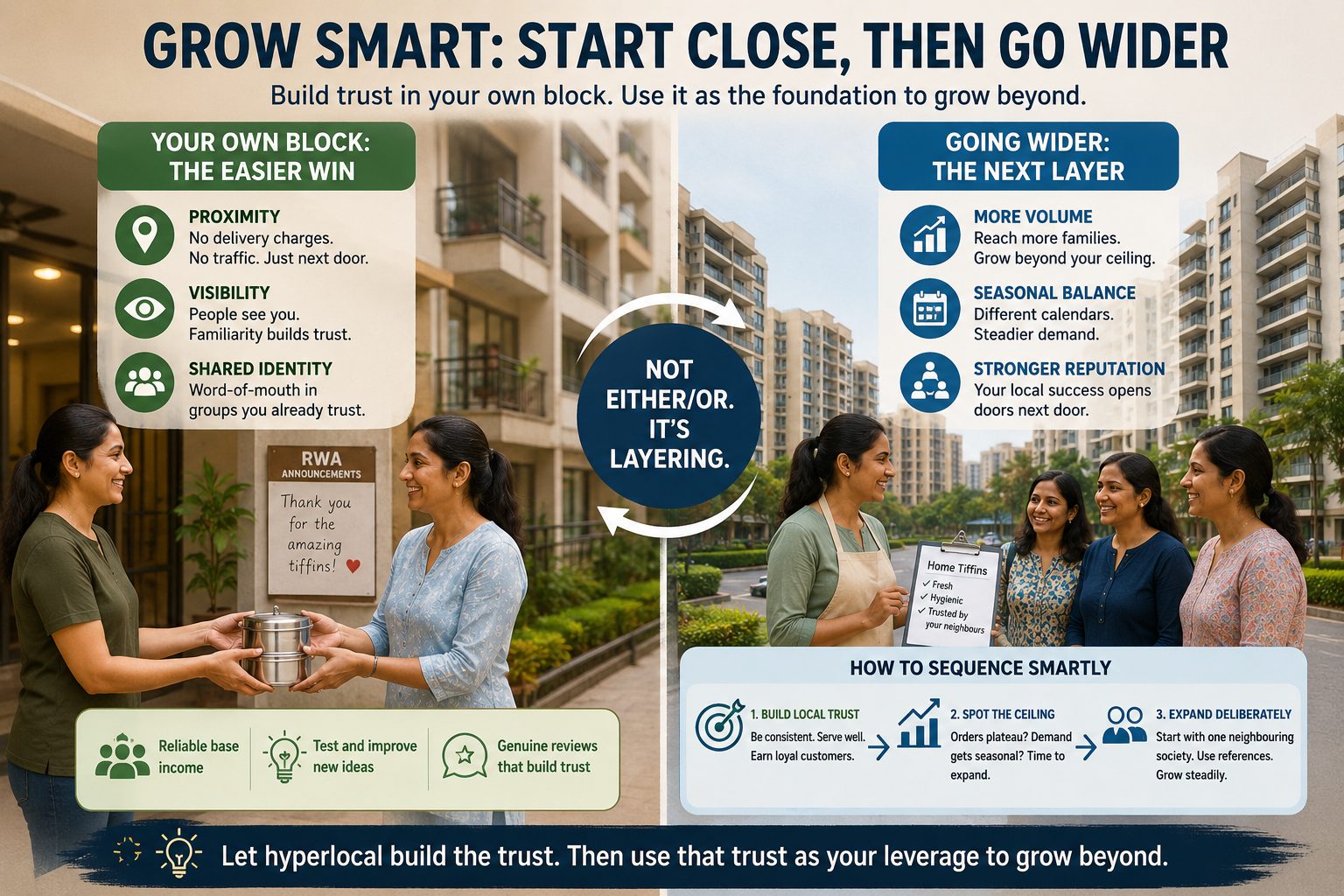
If you run a home business — tiffin service, baking, tailoring, tutoring, fitness training — you'll eventually face a version of the same question: should you focus on winning over the 200 families in your own apartment block, or spend that energy trying to reach the next ten societies down the road?
It feels like a growth question. It's actually a trust question, and the answer changes depending on what stage you're at.
Why your own block is the easier win
Your building already has three things that a stranger three kilometres away doesn't: proximity, visibility, and a shared identity.
Proximity means logistics practically disappear. No delivery charges, no traffic-dependent ETAs, no "sorry, running late" messages. You can hand-deliver a tiffin box on your way to the lift, or have a student walk over for a tuition session without either of you losing half an hour to travel.
Visibility means marketing is mostly passive. People see you in the lobby, at the gym, dropping your kids to the bus stop. That familiarity does more for trust than any Instagram post — a neighbour buying from "the lady from B-Block, 4th floor" feels fundamentally safer than buying from an unknown seller online, even if the product is identical.
And shared identity means word-of-mouth travels through channels you don't have to build. Every apartment complex has its WhatsApp groups — parents' group, ladies' group, the general RWA announcements group. One good review in the right group can bring you five customers by evening. You don't own that channel, but you don't need to; it already exists, and it already has one thing every new business struggles to get: assumed credibility.
This is why almost every successful home business starts hyperlocal, whether or not the owner planned it that way. It's not a strategy so much as the path of least resistance.
Where "just your block" starts to cap out
The same closeness that makes your building easy to serve will eventually limit how much you can grow inside it.
There's a hard ceiling on how many customers one building can realistically give you. If you're running a home bakery and even 15% of your society's 200 families order from you regularly, you've likely captured most of the demand that exists — not everyone wants cake every week, and some households will simply prefer a different vendor no matter how good you are.
There's also a seasonality problem specific to single-building demand. If your building has a lot of families with school-age kids, your tutoring or snack business might do beautifully during the school year and go quiet in April–May when everyone's travelling. A wider customer base averages this out, because not every building's calendar moves in sync.
And there's a slower, less obvious cost: familiarity can flatten your pricing power. Neighbours negotiate differently with someone they see every day. It's harder to hold a price increase, decline a same-day request, or say no to a "society rate" when the person asking lives two floors above you. Sellers who serve customers outside their immediate circle often find it easier to price on the actual value of their work, because the relationship carries less social weight.
Going wider isn't really "leaving" — it's layering
The mistake is thinking of this as an either/or choice, where you graduate out of your building once you're "big enough." In practice, the sellers who scale sustainably keep their own building as the stable core and add wider reach as a second layer on top of it — not a replacement for it.
Your own block gives you three things worth protecting even as you grow: a reliable base income that doesn't depend on discovery or advertising, a live testing ground for new products or prices before you offer them to strangers, and a source of genuine reviews and referrals that carry weight precisely because they come from people your new customers can, in theory, verify.
Wider reach — the next society over, a nearby micro-market, a broader area — gives you the volume and diversification your own building can't. But it usually converts better once you're not doing it cold. A trainer who's built a reputation in one society finds it far easier to walk into an RWA meeting at a neighbouring one and say "I already run sessions two blocks away" than to start from zero.
A simple way to think about sequencing
If you're just starting out, resist the urge to advertise widely before you've earned trust locally. Spend the first few months making your own building's customers genuinely loyal — respond fast, be consistent on quality, ask for feedback, and show up reliably even for small orders. That reputation is the raw material for everything after.
Once you notice signs of a ceiling — orders plateauing, the same 20–30 households accounting for most of your revenue, or demand becoming predictably seasonal — that's your cue to start layering outward. Use your existing customers as references, lean on any cross-society community platforms or vendor directories available to you, and expand deliberately rather than broadly. One well-served neighbouring society is worth more than a scattershot presence across ten.
The goal isn't to choose between "hyperlocal" and "wider." It's to let hyperlocal do what it's good at — building the trust that's expensive to manufacture any other way — and then use that trust as leverage when you're ready to grow beyond the building you started in.
Comments
Sign in to comment.
No comments yet.