
Starting a Laundry Business in an Indian Metro: Steps, Investment and Unit Economics (2026)
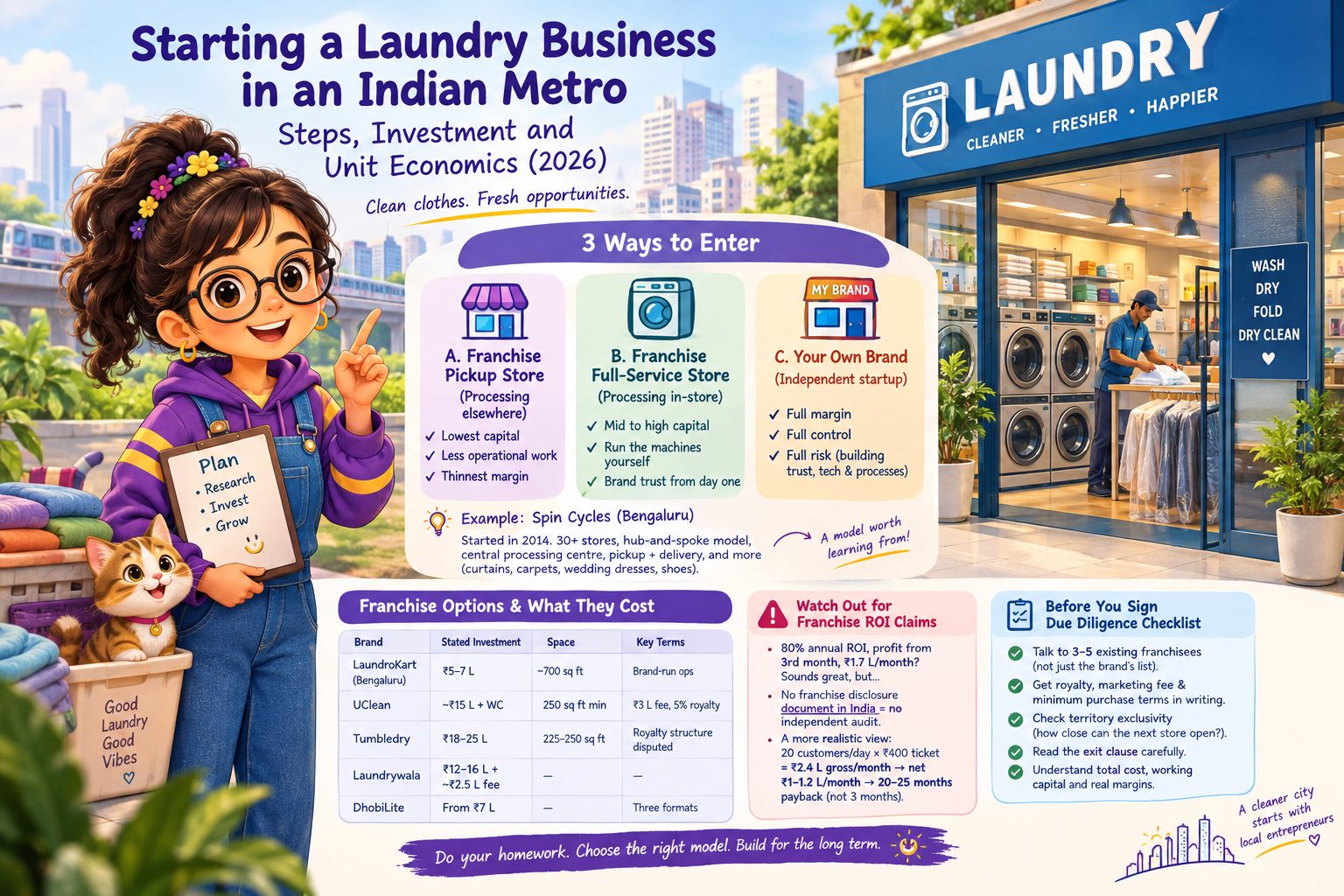
Laundry is a good business for a metro because demand repeats every week, there is no stock that goes stale, and most of the market is still local dhobis and small shops. It also has real risks: machines wear out, garments get damaged, and the pitch decks of franchise brands tend to overstate profits. This guide covers the three realistic ways to enter, what each costs, the licences you need, and what the numbers look like once rent and salaries are paid.
1. Choose your model first
The model you pick decides almost everything else: capital, space, staffing and risk.
Model A: Franchise pickup store (processing done elsewhere). You run a small storefront and pickup/delivery. The brand washes and dry-cleans the clothes at a central factory. This has the lowest capital and the least operational work, but also the thinnest margin.
Model B: Franchise full-service store (processing in-store). You run the machines yourself under a brand's name, systems and app. It needs mid-to-high capital, and you get brand trust from day one.
Model C: Your own brand (independent startup). You get full margin and full control, and you carry the full risk of building customer trust, software and processes yourself.
A useful benchmark for Model C is Bangalore's Spin Cycles. It started in October 2014 to make laundry services more accessible and convenient, and it now has 30+ stores where customers can walk in, alongside pickup service. Its structure is hub-and-spoke: it runs its own processing centre with its own machines and chemicals, and offers doorstep pickup plus curtain, carpet, wedding-dress and shoe cleaning. Many small stores act as collection points and feed one central plant. That is the model most successful independents grow into.
2. Franchise options and what they cost
Brand Stated investment Space Key terms LaundroKart (Bengaluru) ₹5–7 L ~700 sq ft (per listing) Brand-run operations UClean ~₹15 L + working capital 250 sq ft min ₹3 L fee, 5% royalty Tumbledry ₹18–25 L 225–250 sq ft min Royalty structure disputed Laundrywala ₹12–16 L + ~₹2.5 L fee — — DhobiLite From ₹7 L — Three formatsLaundroKart. The brand advertises its Bengaluru franchise at ₹5–7 lakh, with margins of up to 40% and break-even in 25–35 months. The structure is unusual. The partner pays an initial setup fee and the store runs on a COCO model, where the company finds the location, sets up the store, hires staff and handles daily operations. In practice this is closer to a passive investment than to running your own business.
UClean. The total is about ₹15 lakh (₹12 lakh capex plus a ₹3 lakh fee), with ₹3 lakh more needed as working capital and a minimum store size of 250 sq ft. A 5% royalty on revenue goes to the parent company.
Tumbledry. The total ranges from ₹18 lakh for the Express model to ₹25 lakh for the Signature model, and needs at least 225–250 sq ft. Be careful with its fee structure. Some brand materials call the investment royalty-free, while an independent review reports a franchise fee plus about 7% royalty from month one. Get the exact structure for your city in writing before you sign.
Laundrywala. Its model needs roughly ₹12–16 lakh for machinery, setup and basic inventory, plus a franchise fee of about ₹2.5 lakh.
DhobiLite. It advertises entry from ₹7 lakh, across 79 cities and 185+ outlets. Its three formats range from a pickup point to a full storefront to a city-level master franchise.
A warning about franchise ROI claims. Tumbledry markets an 80% annual ROI, profit from the third month, and ₹1.7 lakh a month. An independent review points out that India has no Franchise Disclosure Document requirement, so none of these figures are independently audited. Its conservative model gives a more realistic picture:
- At 20 customers a day and a ₹400 average ticket, a store grosses about ₹2.4 lakh a month.
- After royalty, staff, rent and chemicals, net profit is closer to ₹1–1.2 lakh a month, which means payback in roughly 20–25 months, not three.
Use that as your planning baseline.
Due diligence before signing any franchise:
- Talk to 3–5 existing franchisees yourself, and pick them yourself rather than taking the brand's list.
- Get the royalty, marketing-fee and minimum-purchase terms in writing.
- Check territory exclusivity: how close can the next store of the same brand open?
- Read the exit clauses, and whether you can resell the equipment.
3. Investment for your own brand (metro, 400–600 sq ft with in-store processing)
These are my working estimates for Bangalore, Pune or Hyderabad. Mumbai and Delhi rents will push the totals higher. Get local quotes before you finalise.
Item Estimate Rent deposit (6–10 months) ₹3–5 L Interiors, 3-phase electrical, plumbing, drainage ₹2–4 L 2 commercial washers (18–25 kg) ₹3–7 L Commercial tumble dryer (25 kg) ₹1.5–3 L Steam iron / vacuum finishing table + small boiler ₹1–2.5 L Water softener + basic effluent treatment ₹0.5–2 L POS/laundry software, garment tagging, racks ₹0.3–1 L EV scooter for pickup/delivery ₹1–1.5 L Registrations, CA, legal ₹0.3–0.5 L Launch marketing ₹1–2 L Working capital (4–6 months of runway) ₹4–6 L Total ~₹18–35 LEquipment price ranges. Indian-made machines are much cheaper than imported brands. A 25 kg commercial machine from a Ludhiana manufacturer is listed at ₹1.5 lakh, and a fully automatic 25 kg washer-extractor from a Tamil Nadu supplier is priced around ₹3.3 lakh. Premium or advanced machines cost more: one market overview puts commercial-grade machines at about ₹4 lakh, rising to ₹8 lakh for advanced models.
Dry cleaning: outsource it at first. Dry cleaning equipment can cost upwards of ₹3.5 lakh. It also involves solvents and extra compliance. Send dry-cleaning work to a local plant and keep a 30–40% margin on it until your volumes justify buying a machine.
A lean way to start. You can run a collection-only store for about ₹4–8 lakh and outsource all processing to an existing plant. This lets you prove demand before spending ₹10 lakh+ on machines. As one guide puts it, two commercial front-load machines and one dryer are enough to test the market; don't overbuy capacity at the start.
4. Licences and compliance
Core registrations: commercial laundries generally need MSME Udyam registration, GST registration, Shops and Establishments Act registration, and a municipal trade licence.
Pollution control. Wastewater is the compliance item people most often miss. In most states, commercial laundries need clearance from the State Pollution Control Board, or a letter confirming their effluent disposal meets local standards. Rules and thresholds vary by state, so check with the Municipal Corporation and the Pollution Control Board early; they often decide whether you need an effluent treatment plant. Spin Cycles turned this into a selling point: it uses a purpose-built effluent treatment plant and reuses most of its water.
Other items to check:
- A landlord NOC for rented premises.
- A fire NOC, and a boiler licence if you use a steam boiler.
- EPF/ESI once your headcount crosses the thresholds.
- Insurance for equipment and for customer garments.
GST. Laundry and dry-cleaning services attract 18% GST. One common confusion: the ₹40 lakh threshold you'll see quoted applies to goods. For services, the registration threshold is generally ₹20 lakh, or ₹10 lakh in special-category states. Register early anyway. Corporate, hostel and PG clients will want GST invoices, and you can claim input credit on machines and chemicals. Confirm the details with your CA.
Timeline. In most cities, a basic setup can be registered and running within three to four weeks.
5. Step-by-step launch plan
- Weeks 1–3: Validate demand.
- Map a 2–3 km radius around your planned location.
- Count the apartment complexes, PGs, hostels and existing laundries.
- Mystery-shop 3–4 competitors for price, turnaround and quality.
- Survey 50–100 residents about what they spend now and what frustrates them.
- Week 3: Pick a model and structure. Choose between a franchise and your own brand, and between a pickup store and in-store processing. Register as a proprietorship, LLP or private limited company.
- Weeks 4–6: Secure premises.
- Look for a ground-floor unit with 3-phase power, water supply and drainage access.
- Laundry is planned, not bought on impulse, so being close and easy to reach matters more than visibility.
- Weeks 5–8: Complete licences in parallel with the fit-out (see section 4).
- Weeks 6–9: Buy and install equipment.
- Get 3 quotes for each machine.
- Confirm service support exists in your city; machine downtime will cost you customers.
- Negotiate an annual maintenance contract (AMC).
- Weeks 8–10: Hire and train staff. A typical team is 1 store manager, 2 wash/finishing staff, 1 ironing person and 1 delivery rider. Write SOPs for tagging, stain checks and damage handling.
- Week 10: Set up technology.
- Laundry POS software with garment tagging.
- WhatsApp ordering and UPI payments.
- A Google Business Profile, so you appear in local search.
- Week 11: Soft launch.
- Offer a free first pickup or a discount to 2–3 apartment societies.
- Partner with RWAs and facility managers to get a weekly pickup day at the society gate.
- Months 3–6: Build recurring revenue.
- Monthly subscription plans (for example, a fixed number of kg per month).
- B2B contracts with PGs, salons, gyms, Airbnb hosts and small hotels.
- Add-ons such as shoe cleaning, curtains and sofa covers.
6. Pricing and unit economics
Pricing. In metros, wash-and-fold usually sells by the kg and wash-and-iron at a premium. Dry cleaning sells per garment. Premium items such as silk sarees, blazers, bridal wear and shoes carry the best margins. Set your prices against local competitors rather than national averages; rates vary widely by neighbourhood.
Illustrative monthly P&L for an independent store (my assumptions, not audited data):
Line Amount Revenue (~25 orders/day × ₹400) ₹3.0 L Rent –₹0.5 L Staff (5 people) –₹0.8–0.9 L Power + water –₹0.25–0.35 L Chemicals, packaging, tags –₹0.2–0.25 L Delivery, software, marketing –₹0.3 L Operating profit ~₹0.7–0.9 LOn a ₹25 lakh investment, that works out to a payback of roughly 28–36 months. The outcomes that matter:
- Order volume. Moving from 25 to 40 orders a day roughly doubles profit, because rent and salaries stay mostly fixed.
- B2B contracts. These fill machine capacity on weekdays, when household orders are low.
- Damage and loss claims. Keep a written claims policy and photograph premium garments at intake.
7. Common mistakes to avoid
- Trusting franchise ROI claims without checking. Model your own numbers at 50–60% of the brand's projections.
- Buying too much capacity on day one. Idle machines still cost you EMIs.
- Ignoring wastewater compliance. This can shut you down.
- Treating free pickup as free. Delivery cost per order quietly eats your margin. Set a minimum order value.
- Running without a garment-tracking system. Lost clothes are the fastest way to lose a neighbourhood's trust.
8. Which route suits you?
- Limited time, want a mostly passive investment: a brand-operated model like LaundroKart.
- Want to run the business but have no laundry experience: a full-service franchise like UClean or Tumbledry, after thorough checks with existing franchisees.
- Have operations experience and plan to build multiple stores: your own brand. Start with a lean collection store, prove demand, then build a central processing hub that serves several stores, the way Spin Cycles did.
Figures come from brand websites and third-party reviews as of 2026 and change often. Verify all costs, terms and compliance requirements locally, with a CA and legal advisor, before investing.
Comments
Sign in to comment.
No comments yet.