
The ₹0 Startup: How to Test a Home Business Idea Before Spending Anything
Most people don't fail because they had a bad business idea.
They fail because they invest money before discovering whether anyone actually wants what they're selling.
A logo is designed. Packaging is ordered. Social media pages are created. Inventory is stocked.
Then comes the difficult realization:
There are no customers.
The smartest entrepreneurs work in the opposite direction. They validate demand first and invest later.
If you're planning to start a home business, you don't need capital to begin. You need evidence that people are willing to pay.
This is your ₹0 startup framework.
Why Most Home Businesses Never Get Started
Many aspiring entrepreneurs wait for the "perfect time."
- "I need better equipment."
- "I'll start after taking a course."
- "I need a proper brand."
- "I'll begin when everything is ready."
Perfection becomes an excuse for postponement.
The truth is that customers do not buy because your business looks complete. They buy because your product or service solves a problem they have today.
The fastest way to build confidence is not planning.
It is making your first sale.
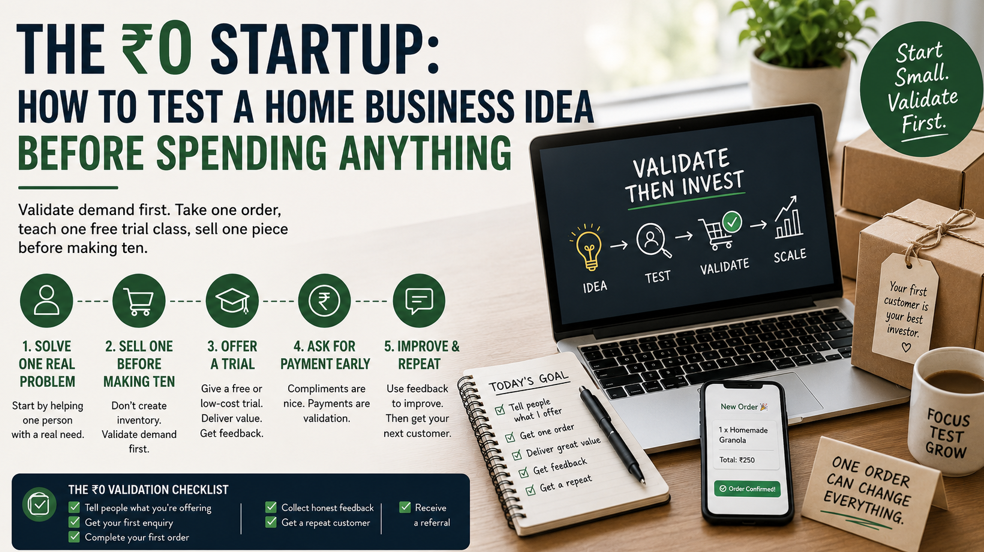
Step 1: Solve One Real ProblemForget building a business.
Start by solving one person's problem.
Examples include:
- Preparing lunch for a busy working professional.
- Altering a dress for an upcoming event.
- Teaching mathematics to one school student.
- Baking a birthday cake for a neighbour.
- Creating handmade jewellery for a friend.
A single paying customer tells you more than weeks of market research.
Step 2: Sell One Before Making TenOne of the biggest mistakes new entrepreneurs make is producing inventory before demand exists.
Instead of making:
- 50 candles
- 30 jars of pickles
- 20 handmade bags
Make one.
Sell it.
Collect feedback.
Then make the second.
This approach protects both your money and your confidence.
If one item doesn't sell, you have learned something valuable without losing thousands of rupees.
Step 3: Offer a Trial Before LaunchingService businesses can validate demand even faster.
Before advertising a full course or monthly package:
- Teach one free trial class.
- Conduct one paid consultation.
- Groom one pet.
- Offer one home salon appointment.
- Train one fitness client.
After the session, ask a simple question:
"Would you pay for this again?"
That answer determines whether you have a business opportunity.
Step 4: Ask for Payment EarlyCompliments are encouraging.
Payments are validation.
Many people will happily say:
"Your cakes are amazing."
Far fewer will actually place an order.
A business exists only when someone is willing to exchange money for what you offer.
Even a small first order proves your idea has potential.
Step 5: Improve Using Customer FeedbackYour first customers become your best advisors.
Ask questions like:
- What did you like most?
- What could be improved?
- Was the price reasonable?
- Would you recommend this to someone else?
These insights help you improve faster than assumptions ever can.
The market tells you what to build.
Listen carefully.
Step 6: Repeat Before InvestingOnly after you've completed multiple successful orders should you begin spending money.
Now it makes sense to invest in:
- Better equipment
- Professional packaging
- Branding
- Photography
- Marketing
- Business registrations
At this stage, you are expanding something that already works instead of hoping it will.
A Simple ₹0 Validation ChecklistBefore investing any money, complete these milestones:
✅ Tell people what you're offering.
✅ Get your first enquiry.
✅ Complete your first order.
✅ Collect honest feedback.
✅ Get a repeat customer.
✅ Receive a referral.
Once you've reached this point, you've already reduced much of the uncertainty that prevents new businesses from succeeding.
Real Businesses Rarely Begin PerfectlyMany successful home businesses started with:
- One customer.
- One WhatsApp message.
- One kitchen.
- One sewing machine.
- One online post.
Not with a storefront, a large investment, or a perfect business plan.
Growth comes from proving demand first and scaling gradually.
Final ThoughtsStarting a home business does not require a large budget.
It requires the willingness to test an idea before investing in it.
Don't wait until everything feels perfect.
Take one order.
Teach one class.
Bake one cake.
Stitch one dress.
Sell one product before making ten.
The first customer is far more valuable than the perfect business plan because it proves something every entrepreneur needs to know:
Someone believes your work is worth paying for.
That is where every successful business truly begins.
Comments
Sign in to comment.
No comments yet.