
A Beginner's Guide to FSSAI Registration for Home Food Businesses (India)
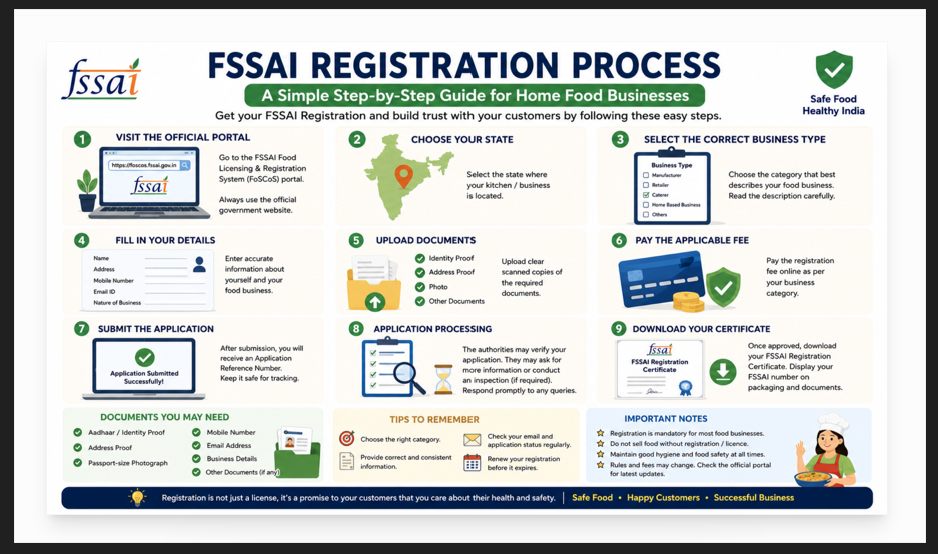
If you're planning to sell homemade food—whether it's tiffins, cakes, pickles, snacks, or festival sweets—you've probably wondered:
"Do I need a licence?"
The answer is yes, but don't let that worry you.
For most home chefs starting small, the process is straightforward. This guide explains everything in simple language.
What is FSSAI?Disclaimer: This guide is for general information only and is not legal advice. Rules and requirements may change. Always verify the latest requirements on the official FSSAI website before applying.
FSSAI stands for the Food Safety and Standards Authority of India.
It is the government body responsible for ensuring that food businesses follow food safety standards.
If you're selling food—even from your home—you generally need to register your food business.
Think of it like getting your business officially recognised.
Do Home Chefs Need FSSAI Registration?Yes.
If you're preparing food at home and selling it to customers, you should obtain the appropriate FSSAI registration or licence before starting regular commercial operations.
This includes:
- Home tiffin services
- Homemade cakes
- Pickles
- Papads
- Sweets
- Snacks
- Catering
- Bakery items
- Homemade chocolates
- Meal subscriptions
FSSAI has different categories depending on the size of your business.
Basic Registration
Suitable for most new home chefs and very small food businesses.
Ideal if you're just starting with a small number of customers.
State Licence
Required once your business grows beyond the limits for Basic Registration or if your operations fall into categories requiring a State Licence.
Central Licence
Generally meant for much larger businesses operating across states, importers, exporters, large manufacturers, or businesses meeting higher regulatory thresholds.
Most home chefs do not start here.
Documents You May NeedRequirements can vary depending on your business and location, but commonly requested documents include:
- Aadhaar or another identity proof
- Passport-size photograph
- Address proof
- Mobile number
- Email address
- Details of your food business
- Address of your home kitchen/business location
Keep scanned copies ready before applying.
Step-by-Step Registration ProcessStep 1: Visit the Official Portal
Go to the official FSSAI licensing and registration portal.
Always use the government website.
Avoid paying third-party agents unless you genuinely need assistance.
Step 2: Choose Your State
Select the state where your kitchen is located.
Step 3: Select the Correct Business Type
Choose the category that best describes your business.
For example:
- Home-based food manufacturer
- Food retailer
- Caterer
Read each description carefully before selecting.
Step 4: Fill in Your Details
Provide information such as:
- Name
- Address
- Contact details
- Nature of food business
Ensure everything matches your identity documents.
Step 5: Upload Documents
Upload the required documents.
Double-check that the files are clear and readable.
Step 6: Pay the Applicable Fee
The registration fee depends on the type of registration or licence.
The portal will display the amount before payment.
Step 7: Submit the Application
After submission, you'll receive an application reference number.
Keep this safely.
You can use it to track your application.
Step 8: Wait for Processing
The authorities may:
- Approve the application
- Request additional information
- Ask for document corrections
- Conduct an inspection if required
Respond promptly if any clarification is requested.
Step 9: Download Your Certificate
Once approved, you'll receive your FSSAI Registration Certificate.
Keep both digital and printed copies.
Display Your Registration NumberOnce registered, you should display your FSSAI registration or licence number wherever required by applicable regulations, such as on food labels or packaging where appropriate.
This helps build customer confidence.
How Long Does It Take?Processing time can vary depending on the application, completeness of documents, and local authorities.
Submitting accurate information and responding quickly to any queries can help avoid delays.
Common Mistakes to AvoidUsing the Wrong Business Category
Read each option carefully before applying.
Uploading Blurry Documents
Use clear scans.
Incorrect Address
Your business address should be accurate and consistent with your documents.
Ignoring Follow-up Requests
Check your email and application status regularly.
Waiting Until You Have Hundreds of Customers
It's better to get registered early rather than after your business has grown.
Simple Hygiene Practices Every Home Chef Should FollowFSSAI registration is only one part of running a good food business.
Customers also expect:
- Clean kitchen surfaces
- Safe drinking water
- Fresh ingredients
- Proper storage
- Separate raw and cooked food where possible
- Clean utensils
- Good personal hygiene while cooking
Happy customers often return because they trust both your food and your standards.
Frequently Asked QuestionsCan I register if I cook from my home?
Yes. Home-based food businesses can apply under the appropriate FSSAI category.
Can I start selling before getting registered?
It's generally advisable to obtain the appropriate FSSAI registration or licence before beginning regular commercial food sales.
Do I need a shop?
No. Many registered food businesses operate from home.
Does FSSAI inspect every home kitchen?
Not necessarily. Inspections depend on the type of application, applicable regulations, and the authority's assessment.
Is the registration permanent?
No. Registrations and licences have a validity period. You should renew them before they expire to continue operating legally.
Final ThoughtsEvery successful food business starts with a single customer.
Getting your FSSAI registration isn't just about complying with regulations—it's about showing customers that you take food safety seriously.
You don't need a restaurant.
You don't need a commercial kitchen.
If you have a clean home kitchen, delicious recipes, and the passion to serve great food, you're already halfway there.
Complete your registration, cook with confidence, and let your passion become a business.
Comments
Sign in to comment.
No comments yet.