
Fitness, Yoga, Dance, Martial Arts — Turning a Passion Into a Neighbourhood Income
If you can teach a surya namaskar sequence, hold a beginner's kalaripayattu stance, or break down a Bollywood step combo, you're sitting on something more valuable than a hobby. Across Indian neighbourhoods, residents are actively looking for instructors they can trust, who live close by, and who understand that not everyone wants a gym membership — some just want a good hour of movement before the day gets busy.
The instructors who turn this into steady income aren't necessarily the most qualified on paper. They're the ones who treat it like a real, if small, business — with a clear format, a reliable schedule, and a way to keep people coming back.
Picking Your Format: Home, Park, or Clubhouse
Each venue has a different rhythm, and most successful instructors end up running more than one.
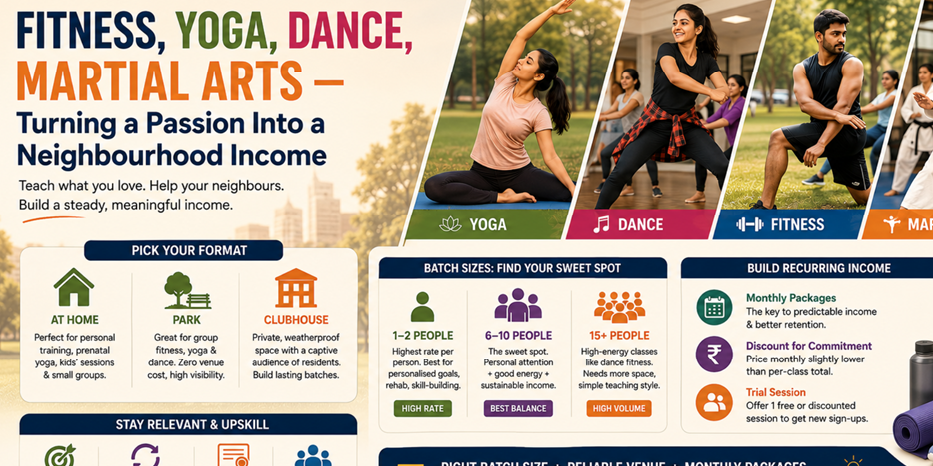
At-home classes work well for personal training, prenatal yoga, or kids' sessions where parents want a controlled, private environment. You're trading scale for higher per-session rates — people pay a premium for one-on-one or small-group attention in a space they're comfortable in.
Park sessions are the classic entry point for group fitness, yoga, and dance-based cardio. Early morning slots (6:00–7:30 AM) and evening slots (6:00–7:30 PM) are when parks fill up with regulars. The upside is zero venue cost and high visibility — people walking their dogs or jogging past will notice a consistent, well-run session and eventually join. The downside is weather dependency and no real privacy or equipment storage.
Clubhouse bookings inside apartment societies are often the most underused option by new instructors, and the most valuable once you get in. A clubhouse gives you a private, weatherproof, sometimes air-conditioned space, and — critically — a captive audience of residents who don't have to travel. Most societies have a facility manager or residents' welfare association (RWA) that handles slot bookings, usually at a modest hourly or monthly rate. Building a relationship with one RWA can fill your entire morning or evening batch without you having to market at all.
A common progression looks like: start in a park to build visibility and a base of regulars, use that credibility to get a clubhouse slot in one society, then add a second society once the first is running smoothly.
Batch Sizes: The Number That Decides Everything Else
Batch size isn't just a logistics detail — it determines your pricing, your teaching style, and your ceiling on income.
- 1-on-1 or duo (2 people): Highest rate per person, best for personalised fitness goals, rehab-focused yoga, or specific martial arts skill-building. Low volume, high margin.
- Small group (6–10 people): The sweet spot for most park and clubhouse sessions. Small enough that you can still correct form and remember names, large enough that per-person pricing can stay affordable while your total session revenue is meaningful.
- Large batch (15+ people): Works for dance fitness or Zumba-style formats where the energy of a crowd is part of the appeal, less so for martial arts or yoga where individual alignment matters. Needs a louder speaker, more space, and a simpler teaching style since individual correction isn't realistic.
A useful rule of thumb: price per person should roughly balance out so that a full small-group batch earns you close to what a duo session would, just spread across more people paying less each. That way you're not tempted to overfill a batch just to compensate for low per-head pricing — which is usually what causes quality (and retention) to drop.
Handling No-Shows Without Killing Your Motivation
No-shows are the single biggest reason instructors burn out or quietly stop showing up themselves. A few practices that experienced instructors rely on:
- Confirm the evening before. A short "see you at 6 AM tomorrow" message to the batch group cuts down no-shows meaningfully — people forget, and a nudge re-commits them.
- Charge monthly, not per-class. This is the single biggest shift (more on this below) — it removes the day-to-day negotiation of "should I go today" from the participant's mind entirely.
- Set a minimum batch policy. If fewer than a set number show up, decide in advance whether you'll still run a full session, a shorter one, or reschedule — and communicate that policy upfront so it doesn't feel arbitrary in the moment.
- Track attendance patterns quietly. If the same 2–3 people repeatedly skip, a private check-in ("everything okay, haven't seen you this week") often surfaces a real reason — schedule conflict, injury, loss of motivation — that you can address before they quietly drop out for good.
Building Recurring Revenue Through Monthly Packages
The instructors who turn this into a stable income, rather than a series of one-off sessions, almost always move to monthly packages early. A few reasons this works better than per-class payment:
- Predictable income. You know at the start of the month roughly what you'll earn, which makes it possible to plan around it rather than chase payments session by session.
- Lower attrition. Once someone has paid for the month, the psychological cost of skipping a session is already sunk — they're more likely to show up to "get their money's worth" than if they were deciding fresh each day.
- Simpler admin. One collection cycle a month (via UPI, typically) instead of tracking who paid for which individual class.
A structure that works well: price the monthly package slightly below what the same number of sessions would cost individually — enough of a discount that it feels like a deliberate choice to commit, not just a convenience fee. Many instructors also offer a short trial (a single free or discounted session) before asking someone to commit to a month, which removes the biggest barrier to a first-time sign-up.
Staying Relevant and Upskilling Without Burning Out
Neighbourhood fitness has gotten more competitive — there's often more than one yoga or dance instructor within a five-minute walk. A few ways instructors stay ahead without needing to reinvent themselves constantly:
- Specialise within your format. "Yoga" is broad; "yoga for lower back pain" or "yoga for working professionals with 30-minute slots" is a specific reason someone chooses you over a generic alternative.
- Rotate content within a stable structure. Participants get bored of the exact same routine, but they also want the reliability of a known format. The trick is to keep the overall session shape consistent (warm-up, main block, cool-down) while rotating specific exercises, sequences, or music every few weeks.
- Get one certification that signals credibility. You don't need a stack of credentials, but one recognised certification (a yoga alliance certification, a martial arts belt/dan recognised by a federation, a dance choreography course) gives new prospects a concrete reason to trust you before they've seen you teach.
- Ask for word-of-mouth, don't wait for it. A simple "if you're enjoying this, a friend or neighbour would be welcome to join" at the end of a good session is often all it takes — neighbourhood word-of-mouth travels faster than most paid marketing for this kind of local, trust-based service.
The instructors who make the most consistent income from this aren't necessarily teaching the most classes — they're the ones who've figured out the right batch size, locked in a dependable venue (often a clubhouse), and shifted their regulars onto monthly packages so the income doesn't reset to zero every week. Once that foundation is in place, upskilling becomes about staying interesting to the people already coming, rather than constantly chasing new ones.
Comments
Sign in to comment.
No comments yet.