
Home Tutors: How to Build a Student Base Without a Coaching Centre
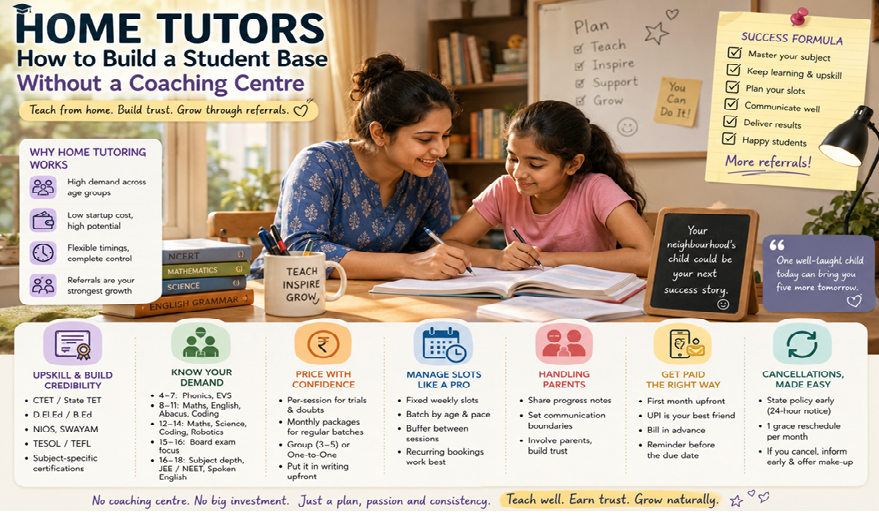
Walk through any residential society in Bengaluru, Pune, or Gurugram on a weekday evening and you'll see it: a knot of children with backpacks heading to the 6th-floor flat where "Ma'am teaches Maths," or the retired schoolteacher three blocks over who's been quietly building a spoken-English batch for two years.
India's urban parents are busier than ever, school syllabi are heavier than ever, and the one thing that hasn't changed is this: a good tutor, teaching from home, remains one of the most trusted and most profitable ways to run a business you control completely.
You don't need a coaching centre, a rented hall, or a signboard. You need a plan.
Upskilling First: Certifications That Make Parents Say Yes
Parents aren't just buying subject knowledge — they're buying confidence that this person knows how to teach. A few credentials go a long way in India, and most are affordable or free:
- CTET / State TET (Central/State Teacher Eligibility Test) — the gold standard if you're tutoring school-going children; instantly signals credibility for CBSE/ICSE households.
- D.El.Ed or B.Ed — if you're building a serious, long-term tutoring practice rather than a side income.
- NIOS and SWAYAM (a Government of India initiative) — free, certificate-backed courses in pedagogy, child psychology, and specific subjects.
- TESOL/TEFL certification — a strong differentiator if you teach or want to teach spoken English or communication skills.
- Subject-specific certifications — Vedic Maths and Abacus certifications (many recognised institutes offer these), coding-for-kids certifications (Code.org, Scratch, CBSE's own coding curriculum training), or Cambridge/IB-recognised training if you want to tutor international-curriculum students.
- Google's Career Certificates or Coursera/edX pedagogy courses — useful if you tutor older students in digital literacy, spreadsheets, or coding fundamentals.
None of these are mandatory to start. But listing even one on your profile — "CTET qualified" or "NIOS-certified in Early Childhood Pedagogy" — changes the conversation with a parent from "why should I trust you?" to "when can we start?"
Know What's in Demand, by Age Group
Don't spread yourself thin. Pick your lane based on where the real demand is:
- Ages 4–7 (Pre-primary/Primary): Phonics, reading readiness, and EVS (Environmental Studies). Parents want confidence-building, not pressure — keep sessions playful.
- Ages 8–11 (Middle primary): Maths and English fundamentals dominate, with growing demand for Abacus, Vedic Maths, and beginner coding (Scratch).
- Ages 12–14 (Middle school): Maths and Science lead, with coding and robotics rising fast as parents look ahead to competitive exams.
- Ages 15–16 (Class 10 board): The single biggest demand pocket in Indian tutoring — board-exam-focused Maths, Science, and Social Science, plus sample-paper and exam-strategy coaching.
- Ages 16–18 (Class 11–12): Subject-specific depth (Physics, Chemistry, Maths, Accountancy, Economics) and foundation support for JEE/NEET aspirants, alongside spoken English and personality development for students preparing for college interviews and beyond.
Pick two or three of these bands and become known for them. A tutor who is "the Class 10 Maths person" in a society WhatsApp group gets referred far more than one who teaches "everything, any age."
Pricing Without Guesswork
Charge in a way that matches how parents actually think about tutoring spend:
- Per-session pricing for trial classes or occasional doubt-clearing — low commitment, easy yes.
- Monthly packages for regular batches (e.g., ₹2,500–₹6,000/month for 8–12 sessions, depending on city and grade) — this is what most urban households expect, since school fees are also monthly/quarterly.
- Group vs. one-on-one — group batches (3–5 students) let you charge less per child while earning more per hour; keep one-on-one for board-exam years where individual attention matters most.
Whatever you choose, put it in writing upfront — a simple message or a printed rate card removes 90% of future payment awkwardness.
Scheduling & Slot Management, the Practical Way
The single biggest operational headache in tutoring isn't teaching — it's scheduling. A few habits fix it:
- Fixed weekly slots, not ad hoc timings. "Every Tuesday and Thursday, 5:30–6:30 PM" is easier for both of you to protect than "whenever works."
- Batch by age and pace, not just convenience — mixing a fast Class 10 student with a slower one frustrates both.
- Build in a buffer between back-to-back students, even 10 minutes, so a late finish with one family doesn't cascade into the next.
- Recurring bookings work far better than re-confirming every week over WhatsApp — once a family commits to a slot, treat it as standing until they tell you otherwise.
Handling Parents Like a Pro
Parents aren't the ones being taught, but they're the ones deciding whether you continue. A few things build long-term trust:
- Share a monthly (or fortnightly) progress note — even three lines: what was covered, where the student is strong, what needs work. Parents rarely ask for this, but they remember tutors who offer it.
- Set boundaries early — decide and communicate your reachable hours for parent queries, so "quick doubt" texts don't arrive at 10 PM.
- Involve them, don't just report to them — a five-minute chat before an exam, or a heads-up before a tricky topic, turns a transactional relationship into a referral-generating one.
Getting Paid, Without the Awkwardness
Money conversations are the most avoided part of home tutoring — and the most fixable:
- Collect the first month upfront, before or on the first class. This isn't rude; it's standard practice, and stating it plainly from day one avoids ever having to "ask" later.
- UPI works best — instant, familiar to every Indian parent, and leaves a clear record for both sides.
- Bill in advance for the month ahead, not arrears — it mirrors how school fees work, so it feels normal rather than transactional.
- For late payers, a friendly, templated reminder message a day or two before the due date (not after) prevents most delays before they happen.
Cancellations, Handled Gracefully
- State your policy before the first class, not after the first missed one — e.g., "24-hour notice for reschedules; a missed session without notice isn't carried forward."
- Offer one grace reschedule per month — it costs you little and buys enormous goodwill.
- For your own cancellations (illness, travel), give as much notice as possible and offer a makeup slot within the week — parents forgive an occasional cancellation far more easily when you're the one managing it proactively, not reactively.
The Feel-Good Part
None of this requires a coaching centre, a big investment, or a marketing budget. It requires one well-taught child whose parent tells another parent in the same building. That's how almost every successful home tutor in urban India actually grows — one confident, recommending family at a time.
Master your subject, respect the parents' time and trust, get your payments and slots organised, and the "student base" builds itself, one referral at a time.
Comments
Sign in to comment.
No comments yet.