
If You Can Cook, You Already Have a Business: A Guide for Home Chefs
There is a common belief that businesses begin with an office, a shop, a logo, and a large investment.
In reality, many successful food businesses begin with something much simpler—a family recipe, a small kitchen, and one person who genuinely enjoys cooking.
Every apartment complex has someone known for their biryani. Every street has someone whose pickles disappear before lunch. Every festival introduces us to someone whose sweets are requested year after year.
If people already ask you to cook for birthdays, festivals, office lunches, or family gatherings, you are closer to owning a business than you think.
The biggest hurdle isn't cooking.
It's believing that you are allowed to sell what you make.
Let's change that.
"Is It Even Legal to Sell Food From Home?"
This is usually the first question people ask.
The good news is yes—home kitchens can legally sell food in India, provided you follow the basic food safety requirements.
For most people starting small, this simply means obtaining an FSSAI Registration, not a complicated commercial licence.
Think of it as registering yourself as a food business operator.
If you're preparing meals or homemade food for customers, this registration gives confidence to buyers and shows that you intend to operate responsibly.
The process is designed for small businesses and is much simpler than many people imagine.
Don't let fear of paperwork stop you before you've even taken your first order.
Refer to the FSSAI Registration Process as of 2026 here.
Start Small Before Thinking Big
One of the biggest mistakes new home chefs make is trying to serve everyone.
Instead, choose one clear offering.
For example:
- Daily lunch boxes for nearby office workers
- Healthy tiffins for students
- Weekend biryani specials
- Homemade cakes
- Pickles and chutneys
- Festival sweets
- Fresh snacks every evening
Customers understand exactly what you're offering, and you become known for that speciality.
It's easier to grow from one successful product than ten average ones.
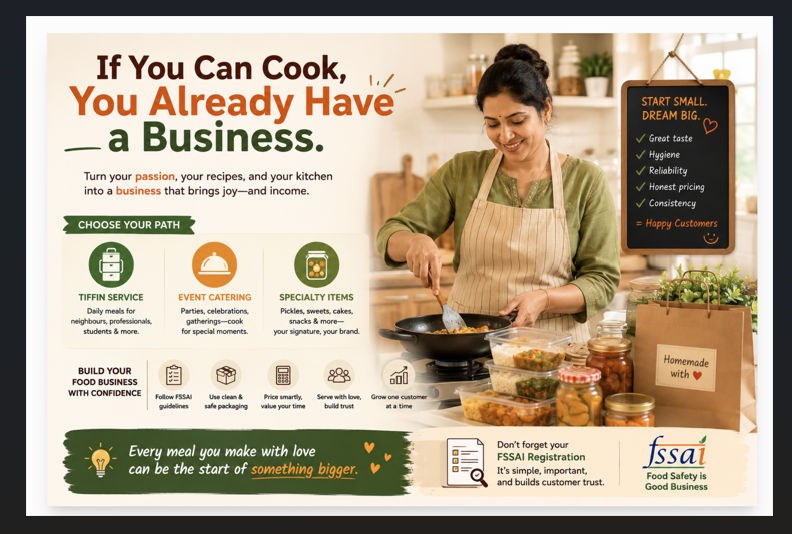
Which Food Business Fits You?There isn't one correct model.
Choose the one that matches your lifestyle.
1. Daily Tiffin Service
Perfect if you enjoy cooking every day.
Ideal for:
- Working professionals
- Students
- Elderly residents
- Bachelors living nearby
Advantages:
- Predictable income
- Repeat customers
- Easier planning
- Less marketing after initial customers
This works especially well if you have a consistent daily routine.
2. Event Catering
Prefer cooking occasionally instead of every day?
Focus on:
- Birthday parties
- Housewarming functions
- Apartment celebrations
- Kitty parties
- Office gatherings
Here, each order is larger but less frequent.
This suits people who have help at home or enjoy cooking for groups.
3. Specialty Items
Some foods don't need daily cooking.
Examples include:
- Homemade pickles
- Spice mixes
- Masalas
- Cakes
- Cookies
- Traditional sweets
- Papads
- Healthy snacks
These products often last longer, making production more flexible.
Many successful home businesses begin with just one signature item.
Packaging Doesn't Need to Be ExpensiveCustomers appreciate neatness more than expensive boxes.
In the beginning, focus on three things:
Keep it clean
Use food-grade containers that seal properly.
Keep it simple
A plain container with a printed label looks professional enough.
Your label can include:
- Business name
- Your phone number
- Date prepared
- Best-before recommendation
Keep it secure
Food should travel safely without leaking or spilling.
That's more important than fancy ribbons or premium packaging.
Remember, customers come back because the food is delicious—not because the box was expensive.
How Should You Price Your Food?Many first-time sellers make one mistake.
They calculate only the cost of ingredients.
But your time also has value.
When pricing your food, consider:
- Ingredients
- Cooking gas or electricity
- Packaging
- Delivery expenses (if you offer delivery)
- Your cooking time
- A reasonable profit
If you're barely covering ingredient costs, you're not running a business.
You're funding someone else's lunch.
Per Meal or Monthly Plans?Both work.
The right choice depends on what you're selling.
Charge Per Meal When:
- Orders are occasional
- You offer special dishes
- You cater for events
- Customers order only when needed
Examples:
- Weekend biryani
- Cakes
- Festival sweets
- Party catering
Offer Monthly Plans When:
You're providing regular meals.
Examples include:
- Daily lunch
- Breakfast subscriptions
- Healthy dinner plans
Monthly plans give you:
- Predictable income
- Better grocery planning
- Reduced food waste
- Loyal customers
Many home chefs start with individual meals and later introduce monthly subscriptions once they build trust.
Your First Customers Are Closer Than You ThinkYou don't need thousands of followers.
You don't need expensive advertising.
Start with people who already know you.
Tell:
- Neighbours
- Friends
- Apartment WhatsApp groups (where permitted)
- Office colleagues
- Family
The first five happy customers often become your best marketers.
Word of mouth has built countless food businesses.
Don't Wait Until Everything Is PerfectMany aspiring home chefs delay starting because they think they need:
- A commercial kitchen
- Professional branding
- A large menu
- Hundreds of social media followers
- Fancy packaging
None of these are required for your first customer.
What matters most is:
- Great taste
- Hygiene
- Reliability
- Honest pricing
- Consistency
Those qualities build trust far faster than expensive marketing.
Your Kitchen Is Already an AssetEvery day, you prepare meals that make people happy.
The only difference between cooking for family and running a food business is that someone chooses to pay for it.
If your recipes bring smiles to friends and neighbours, they already have value.
You don't need permission to believe in your cooking.
You simply need the courage to let one customer try it.
One order becomes two.
Two become ten.
And before long, your kitchen isn't just where meals are made.
It's where your business begins.
How MemuniCity Helps Home Chefs
Starting a food business is easier when your first customers are nearby.
Instead of trying to reach the entire city from day one, MemuniCity helps home chefs connect with people in their own apartment communities and neighbourhoods—people who are already looking for trusted, local options.
Whether you're selling daily tiffins, homemade pickles, celebration cakes, healthy snacks, or festival sweets, you can start by serving customers close to home, build genuine reviews, and grow through word of mouth.
Because every successful food business starts with one meal, one customer, and one neighbour who says, "This is amazing—you should sell this."
Comments
Sign in to comment.
No comments yet.