
The Clubhouse Is Your First Stage
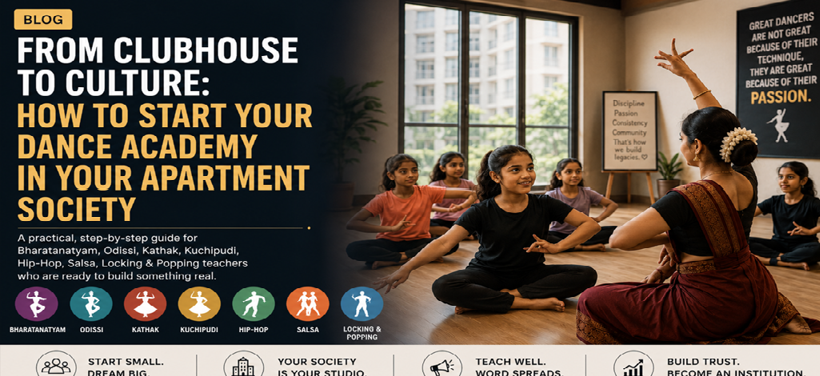
Every major dance academy in this country started somewhere smaller than you'd expect. This is the practical, step-by-step version of how — for Bharatanatyam, Odissi, Kathak and Kuchipudi dancers, and for hip-hop, salsa, locking and popping artists building something new.
14 min read·BharatanatyamOdissiKathakKuchipudiHip-HopSalsaLocking & PoppingSomewhere in this city, in a clubhouse that usually hosts birthday parties and society AGMs, a batch of eight-year-olds is learning their first tatta adavu. In another, a circle of teenagers is drilling a six-count salsa basic before a Friday recital nobody outside the building will ever hear about. Neither space was designed to be a dance school. That's exactly the point.
Every dance institution you'd recognize by name — the ones with waitlists, franchise branches, and alumni on reality television — began the same way: one teacher, a rented or borrowed room, and a handful of students who believed the teaching was good before the brand existed to prove it. Kalakshetra began as a small circle of students around a teacher committed to reviving Bharatanatyam properly. Shiamak Davar and Terence Lewis both built what are now some of India's largest dance institutions out of small studio classes, years before either name meant "academy." The room came after the teaching, not before it.
Your apartment society already has the room. It has flooring, a captive audience of families who trust their neighbours more than any advertisement, a WhatsApp group that moves faster than any billboard, and — if you use it right — the beginnings of a booking and payment system that most independent teachers spend years building for themselves. This guide is the step-by-step version of how to use all of it, honestly and practically, whichever of these forms you teach.
Step 01
Get your credentials in order
Classical forms — credibility has a paper trail
For Bharatanatyam, Odissi, Kathak and Kuchipudi, parents in most Indian cities are used to a specific credibility ladder, and it's worth knowing it even if your own training took an unconventional path.
- Guru-shishya lineage still matters more than any certificate — who you trained under, and for how long, is usually the first question a parent asks.
- An arangetram — the traditional solo debut marking the completion of foundational training — remains the single most recognized credibility marker for Bharatanatyam and Kuchipudi specifically. If you've given one, say so plainly, on your listing and in conversation.
- Structured diploma exams exist and are worth having if you don't already: the Akhil Bharatiya Gandharva Mahavidyalaya Mandal and Prayag Sangeet Samiti both run graded, pan-India examinations across classical dance styles, recognized well outside the city they're based in.
- For Odissi, training lineage traced to Nrityagram Dance Village or a recognized Odissi guru carries real weight. For Kathak, a diploma from Kathak Kendra in New Delhi (under the Sangeet Natak Akademi) is the closest thing to a national standard. For Kuchipudi, training rooted in Siddhendra Kalakshetra in Kuchipudi village is the traditional benchmark.
- If your own training doesn't map neatly onto any of this, don't fabricate a lineage — state your actual training clearly (teacher's name, years, style) and let your performance video do the rest of the persuading. A parent who watches a clean adavu will trust it over a vague qualification.
Hip-hop, locking, popping and salsa — credibility is earned in public, not printed
These forms don't have a single certifying body the way classical Indian dance loosely does, and pretending otherwise won't help you. What actually carries weight:
- Competition and battle standing — placements at recognized battles and jams are the closest equivalent to a diploma, and far more persuasive to a prospective student who's done any research at all.
- Teacher-training under an established institute — Shiamak Davar's Institute for the Performing Arts and Terence Lewis Contemporary Dance Company have both run structured instructor-certification tracks at various points; training or certifying under a recognized studio name is worth listing explicitly.
- Zumba Instructor Network (ZIN) licensing is real, inexpensive and globally recognized if any part of your offering leans into dance-fitness formats.
- For salsa and partner social dance, ISTD (the Imperial Society of Teachers of Dancing) runs a recognized Latin-American teaching syllabus — more commonly used by competitive ballroom/Latin teachers than street salsa instructors, but the most internationally recognizable credential available if you want it.
- Absent any of the above, your reel is your resume. A well-shot minute of you actually dancing, and a second one of your students actually dancing, will do more for your credibility with a distracted apartment-complex parent than any certificate on a wall.
What every style needs, regardless of form
Three things stop being optional once you're teaching other people's children in a residential building:
- A police verification / character certificate from your local station — inexpensive, and often the first thing a cautious RWA or parents' committee asks for before anyone else does.
- Basic first-aid / CPR training — cheap, widely available, and directly relevant to a physically active class.
- A working awareness of child-safety norms (POCSO, in Indian law) — even a short, documented orientation signals seriousness, and is simply the right thing to have in place.
Step 02
Choose and prepare your space
Most apartment societies already own more dance-ready space than they realize — it's just labelled "multipurpose hall" or "party lawn" instead of "studio."
- Flooring: a sprung wood or marley floor is the gold standard; where that's not available, a smooth, non-slip hard floor beats any carpeted surface — avoid raw ceramic tile for anything involving jumps, turns or bare feet. Interlocking foam mats are a legitimate, inexpensive stopgap for a Tiny Movers batch.
- Mirrors: not essential for a first batch, genuinely useful from the intermediate level onward — technique correction is much harder without one.
- Sound: a decent Bluetooth speaker is enough to start; budget for a proper portable PA system once you're running more than two batches a week.
- Room to move: roughly 12–15 sq. ft per student as a minimum for anything beyond seated or basic work — more for styles involving lifts, jumps or partner turns.
- Safety basics: padded or covered pillars and sharp corners, adequate ventilation, a clearly marked entry/exit, and — for barefoot classical forms — a floor that's actually clean, not just available.
- Realistic venues inside a typical society: the clubhouse multipurpose hall (most common), a covered terrace or party lawn (weather-dependent, good for larger batches or performances), an underused basement or activity room, or — for a single dedicated batch — even a large flat's living room, if the RWA is comfortable with it.
Step 03
Formalize it with your RWA
The single most common way a promising batch collapses in month three isn't a bad class — it's an informal space arrangement nobody wrote down. Treat your Resident Welfare Association or Apartment Owners' Association like the landlord it effectively is.
- Put the arrangement in writing, even informally over email — days and times, which room, who's responsible for cleaning up, and what happens if the hall is double-booked for a wedding.
- Decide the money question upfront: a flat monthly rent for the room, a small revenue share, or "free to residents, paid access for outside students" are all common arrangements — ambiguity here causes disputes later, not the amount itself.
- Ask about liability before anyone asks you: a simple written consent/waiver form from parents, and — once you're running more than a casual batch — a basic public liability policy, is inexpensive and exactly the kind of seriousness that turns a hesitant RWA into a yes.
- Bring the cultural committee in early, not just the facilities manager — they usually decide whether you get the good slot for Diwali or Republic Day, and that stage slot is worth more to enrollment than a month of flyers.
Step 04
Prove you can teach, before anyone pays
Credibility inside a residential community isn't won with a certificate on a wall — it's won in the two minutes before a parent decides you're worth their child's Tuesday evening. In order of what actually converts:
- A free, well-publicized open house or demo class — the single highest-converting thing you can do, and it costs you one hour.
- A 60–90 second reel — your own dancing, then your students' — shared in the society WhatsApp group and on Instagram; dance is one of the few things that genuinely benefits from short-form video, so use that.
- Written testimonials from your first few parents, collected deliberately (ask, don't wait) and displayed on your listing and at your venue.
- A slot at the society's own festival stage — Diwali, Independence Day, Republic Day, Ganesh Chaturthi, whatever your community celebrates — is worth more than any flyer. It's a stage your entire potential customer base already attends voluntarily.
- Visible credentials, physically at your teaching space and listed clearly on your MemuniCity profile — not because a framed certificate teaches anyone anything, but because its absence, next to a competitor who has one, reads as a gap.
Step 05
Get the word out — and use MemuniCity properly
Split your advertising into what's genuinely hyperlocal and what's digital, and don't over-invest in the second before you've exhausted the first.
Hyperlocal — do this first, it's nearly free
- The society WhatsApp broadcast group and noticeboard — still the highest-trust channel inside any Indian apartment complex.
- A simple flyer at the gate or mailbox area, timed around the start of a school term.
- A banner at the clubhouse itself, visible to every resident on the way to the gym or the pool.
Digital — once the hyperlocal channel is working
- Instagram Reels of actual class footage — the algorithm rewards dance content specifically, and it's the cheapest content you'll ever make, since the "content" is literally your class.
- A Google Business Profile once you're running more than one batch, so a parent searching "dance classes near [society name]" finds you.
- A YouTube channel for longer recital footage, worth it once you have enough of it.
How to actually use MemuniCity for this
This is where the hyperlocal advantage compounds instead of just sitting in a WhatsApp group's chat history. Here's the specific playbook:
- Sign up and complete onboarding with your own home society and flat — free, and takes a few minutes.
- Register as a seller from the Seller Hub: phone, address, Aadhaar and PAN details, and the supporting documents — images or PDFs are both accepted. An admin reviews and approves this before you can list, usually within a day or two.
- Create your listing as a Service, category Dance Classes, with real photos and a description that actually says what you teach and how — not just "dance classes available."
- Choose your cadence deliberately: Monthly is what most ongoing batches want; use One-off for a single workshop or masterclass, or Daily for an open drop-in practice slot.
- Set up real slots, not a vague listing — each slot is an actual timetable entry (say, "Tue/Thu, 5:30–6:30pm, Foundation batch") with its own seat capacity, so a full batch shows as full instead of quietly over-enrolling.
- Turn on Subscribe for your monthly batches — a parent authorizes one auto-debit (UPI Autopay or eMandate) and is billed automatically every cycle after that; no chasing fees on the 3rd of every month. Your first several transactions on the platform are free before any subscription or commission applies, so there's no cost to trying this.
- Set the listing's location to where you actually teach — if that's a different society's clubhouse than the one you live in, say so. MemuniCity matches families by real distance to where the class actually happens, not to your home address, so the right nearby families find you.
- Write blog posts attached to your listing — a recital write-up, a "meet the teacher" post, a student spotlight, with real photos. Each post carries one-tap social share buttons and a direct link back to your class listing, so a parent sharing your recital post in their own friend circle sends new families one tap away from actually enrolling, not just admiring.
- Let your ratings do the persuading — once a family has completed a paid cycle, they can rate you. A strong, visible rating is worth quoting in your own advertising once you have a handful.
- Use chat for the questions that come before a decision — "what should she wear," "do you provide the ghungroos," "can he join mid-term" — answered directly, before a hesitant parent talks themselves out of enrolling.
Step 06
Build the collaborations that make it an academy
Every teacher who's scaled past a single batch has done it through relationships, not just marketing spend.
- Your RWA and cultural committee, as an ongoing partnership, not a one-time approval — offer resident discounts, host the festival showcase every year, and you become the community's dance teacher rather than a tenant of its clubhouse.
- Fellow instructors, across styles — a Bharatanatyam teacher referring a student toward a hip-hop batch for cross-training, and back again, grows both of you; teachers who treat each other as competitors inside the same complex are leaving students on the table.
- Musicians and accompanists — a live nattuvanar for Bharatanatyam, a tabla player for Kathak, a DJ for a hip-hop showcase — are the difference between a class and a genuine performing-arts presence, worth bringing in even occasionally once you can afford it.
- Schools nearby, for after-school programs and holiday camps — the same pitch that works on a parent works, at scale, on a school administrator.
- A photographer or videographer — even a talented parent with a good phone — documenting your recitals properly; that footage becomes next year's enrollment reel.
- A physiotherapist or sports-medicine contact, once you're serious — injury prevention and quick answers for worried parents are part of running this like the real academy you're building, not a hobby.
None of this requires you to be Shiamak Davar or Terence Lewis before you start — it requires you to run one good batch, in one real room, for one real group of families, well enough that they tell the next building over. That's how the room after this one gets bigger. The clubhouse was never the ceiling. It was the first stage.
Comments
Sign in to comment.
No comments yet.