
The Neighbourhood Economy: How Two Kinds of People, Living Two Doors Apart, Can Solve Each Other's Biggest Problem
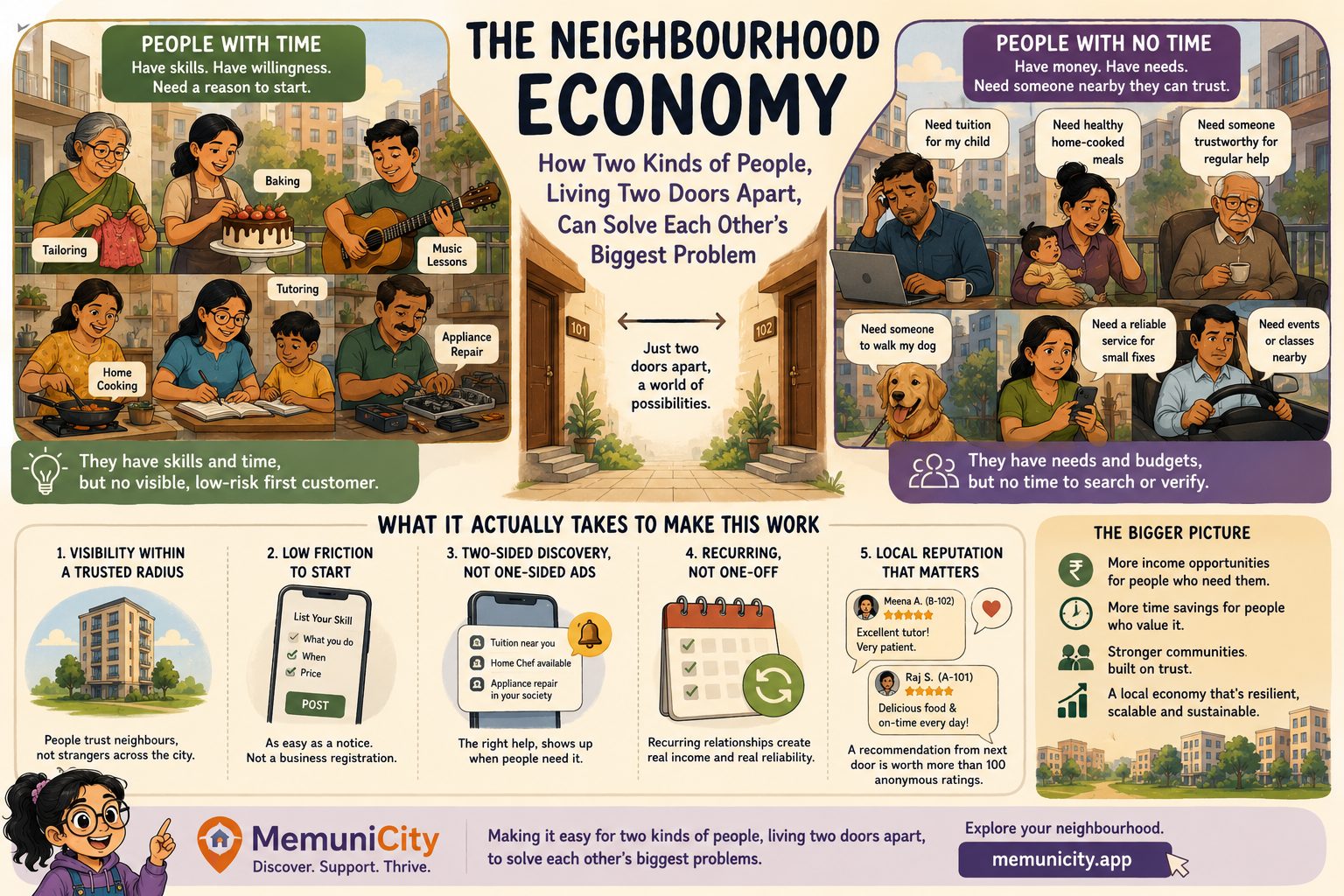
On one side: people with time — retirees, homemakers, students, career-breakers, people between jobs, people with a skill they've never monetised. Cooking. Tailoring. Tutoring. Baking. Fixing things. Organising events. Teaching an instrument. They have the ability and the willingness to work. What they lack is a reason to start — a visible, low-risk first customer.
On the other side: people with none of that time. Dual-income households, people working long hours, parents juggling school runs and deadlines, elderly residents who need help but don't know who to trust. They have money they'd happily spend to get an hour of their life back. What they lack is someone nearby they can trust enough to hand that task to.
These two groups live in the same building. Often the same floor. And yet, more often than not, they never find each other — because the systems built to connect people were built for cities, not for neighbourhoods.
Why This Gap Exists
Unemployment in India isn't purely a jobs-availability problem. A huge amount of it is a discovery and trust problem. Someone in your society may be an excellent baker, or brilliant at spoken English tutoring, or genuinely skilled at appliance repair — and you would never know, because there's no mechanism for that skill to surface where it's needed.
Meanwhile, the person who needs a tutor for their child, or someone to walk their dog, or a tiffin service that isn't from three localities away, ends up searching apps built for an entire city — apps where trust is a star rating from a stranger, not a face you recognise from the lift.
The result: skilled, willing people stay idle. Busy, willing-to-pay people stay underserved. And the value that should have been created — and the income that should have changed someone's month — simply evaporates.
What "Home Business" Really Means Here
This isn't about everyone becoming an entrepreneur in the startup sense. It's smaller and more achievable than that.
It's the retired schoolteacher three floors up tutoring two kids after school. It's the homemaker who bakes exceptional cakes finally selling them instead of just gifting them at Diwali. It's the college student earning through evening pet-walks for four families in the same block. It's someone semi-retired offering appliance repair two mornings a week because he's good at it and misses being useful.
None of these people need a business plan, a loan, or a storefront. They need customers who are close enough to reach, and trusted enough to say yes to.
What It Actually Takes to Make This Work
If we want this kind of neighbourhood economy to function at scale — not as isolated word-of-mouth luck, but as something every society can rely on — a few things need to be true:
1. Visibility within a trusted radius. People are far more willing to try a new service, or hire someone new, when the person is from their own building or block — not a stranger from across the city. Proximity does the trust-building that reviews and ratings try to fake.
2. Low friction to start. A person who's never sold anything before will not fill out a business registration form to teach two piano students. The first step has to be as easy as putting up a notice that reaches the right ten households, not the whole internet.
3. Two-sided discovery, not one-sided advertising. It's not enough for providers to be visible. The people looking for help — often too busy to search actively — need this to surface to them, at the moment they realise they need it, without effort.
4. Recurring, not one-off. The real economic impact isn't a single transaction. It's a tutor who teaches three times a week for a year. A tiffin service with the same twenty families every month. Recurring relationships are what turn "some extra pocket money" into an actual, dependable income stream — and what turn "I hired someone once" into "I have someone I rely on."
5. Reputation that stays local. A five-star rating from an anonymous city-wide app means little. A recommendation from the family two doors down means everything. The trust mechanism has to work the way word-of-mouth already works in a society — just faster and more reliably.
The Bigger Picture
Scale this across a neighbourhood, a society, a city — and you're not just filling idle hours or saving people time. You're building a form of local economic resilience that doesn't depend on large employers, doesn't require anyone to relocate, and doesn't leave people waiting for "the market" to create a job for them.
It's a quieter kind of employment — but it's real. A homemaker earning ₹15,000 a month from four regular tutoring students isn't in any unemployment statistic, but her household budget just changed. A retired professional offering two services a week isn't drawing a salary, but he's earning, staying engaged, and staying useful — which matters as much as the income itself.
Unemployment isn't only solved by new companies hiring more people. Sometimes it's solved by letting people who already live five metres apart finally see each other.
The infrastructure for that doesn't need to be complicated. It just needs to start local, stay local, and make the first step easy enough that people with a skill — and people with none of the time to learn one themselves — can find each other before either of them gives up looking.
Comments
Sign in to comment.
No comments yet.