
Your apartment society already has 40 businesses in it. You just don't know about them.
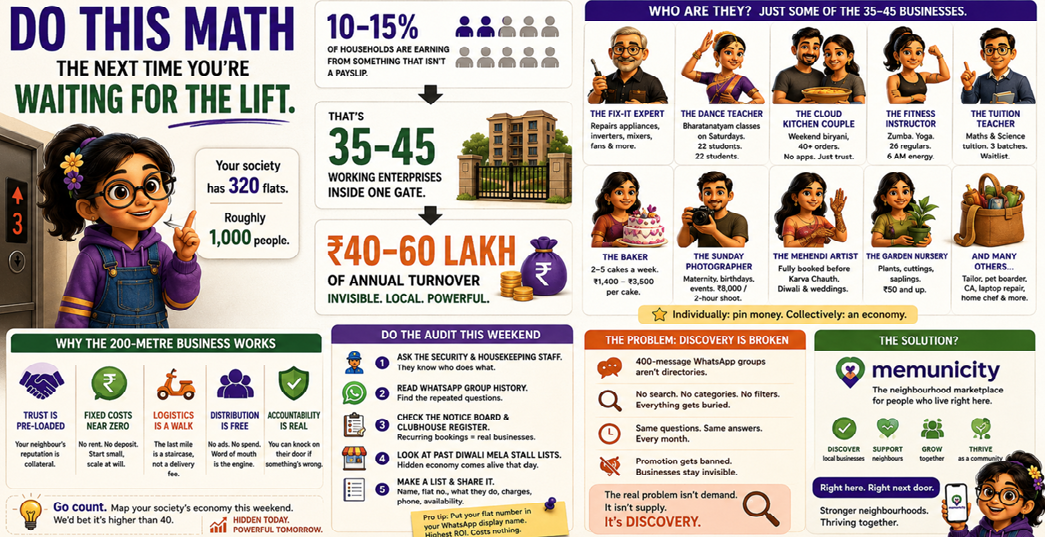
Do this math the next time you're waiting for the lift.
Your society has, say, 320 flats. Roughly a thousand people. Of the adults, a good number are salaried and only salaried. But somewhere between 10 and 15 percent of those households are earning money from something that isn't a payslip — a tuition batch, a cake order, a Saturday dance class, a side consulting gig, an eBay-and-OLX habit that quietly became a business.
That's 35 to 45 working enterprises inside one gate.
Not "potential" businesses. Not "if only they had a platform." Running ones. Ones with repeat customers, UPI QRs, WhatsApp broadcast lists, and in a few cases GST numbers. In a mid-size society in Sarjapur or Wakad or Sector 57, this hidden economy easily crosses ₹40–60 lakh of annual turnover — all of it invisible to the people living directly above and below it.
Here's who they are.
The archetypes
The retired uncle who fixes everything with a mains cord
Third floor, B block. Thirty-one years at BEL or HAL or BHEL, took VRS in 2016, and has a workbench on the utility balcony that would embarrass most service centres. He will open your mixer grinder, tell you the carbon brushes are worn, replace them for ₹180, and refuse to take money the first time because "arre, it's two minutes."
By the third time he takes money, because you insisted, and because he's now doing four of these a week — geysers, inverters, that one induction cooktop the brand has discontinued, ceiling fan regulators, the treadmill in the gym that the AMC vendor keeps saying needs a full board replacement.
He is not on JustDial. He will never be on JustDial. He's found entirely by someone in the lift saying "aap 802 wale uncle se poochho."
Why it works: The formal repair economy has almost abandoned out-of-warranty small appliances — the brand tells you it's cheaper to buy new, and it usually is, if you value your time at their labour rates. He doesn't. He has time, a multimeter, and forty years of intuition about what actually fails.
The Bharatanatyam teacher in the community hall
Saturdays, 4 to 6 pm, the hall that otherwise hosts AGMs and the annual Ganesh Chaturthi. Twenty-two students, mostly 6 to 14, mostly girls, ₹1,200 to ₹1,800 a month. She trained for fourteen years, has a Vidwat degree nobody in the society knows about, and quit a Bangalore IT job after her second child.
She pays the RWA a nominal hall charge — ₹500 a session in some societies, nothing in others, and in a few, an ugly committee argument about it. Every eighteen months she does an arangetram or a showcase, and for that one evening, the entire society finds out she exists.
Then it goes quiet again.
Why it works: Parents will not put a seven-year-old in an autorickshaw to Malleswaram twice a week. The competitor isn't a better dance school; the competitor is the class not happening at all. Proximity is the product.
The couple running a cloud kitchen out of a 2BHK
He's in product at a fintech, she was in hotel management before Kochi, and what started as "we made too much biryani, take some" during the second lockdown is now forty-odd orders every weekend. Kerala-style, Thalassery, marinated Friday night, dum on Saturday morning, delivered by their society-gate security guard's cousin on a Splendor for ₹30 a drop.
They are not on Swiggy. Getting on Swiggy means an FSSAI registration for a residential kitchen, 25-odd percent commission, packaging that survives forty minutes, and competing on price with a dark kitchen in Kadubeesanahalli that has industrial equipment. Instead they have a WhatsApp status posted Thursday, a Google Form that closes Friday 9 pm, and a customer base that is 90 percent within 500 metres.
Their margin is roughly triple what an aggregator listing would give them. Their cost of acquiring a customer is one lift conversation.
Why it works: Zero delivery cost, zero commission, zero marketing spend, and a trust premium that no cloud kitchen brand can buy — you can knock on their door if the biryani is bad.
The 6 am clubhouse instructor
Zumba on Monday-Wednesday-Friday, yoga on Tuesday-Thursday, ₹800 a month, twenty-six regulars, most of whom joined because they saw the class happening while walking to the parking. She has a certification from a Pune institute and one prior attempt at a standalone studio in HSR that died in eight months to rent.
The society clubhouse costs her nothing or nearly nothing. Her customers walk down in slippers. Her retention is extraordinary, because quitting means being seen not going.
The tuition class in Tower C
Class 9 and 10 maths and science, three batches, ₹2,500 a month per student, and a waitlist. The father does it in the evenings; he's an engineering college lecturer by day. During board exam season he adds a Sunday doubt-clearing session.
Somewhere else in the same society, there's a woman doing spoken English and phonics for the 4-to-7 set, and a retired banker doing CA Foundation accountancy for exactly six students. None of the three knows the other two exist.
The one who bakes
Started with a lockdown course, a ₹9,000 OTG, and a cousin's birthday. Now does two to five cakes a week — the tall ones with the buttercream flowers, the Instagrammable ones, ₹1,400 to ₹3,500. Her Instagram has 900 followers, of whom maybe 40 live within 2 km, and she has quietly figured out that her actual sales channel is society mothers tagging her in birthday photos.
Egg-free on request, which in a lot of Indian societies is not a nice-to-have; it's half the market.
The Sunday photographer
Business analyst at a consulting firm, ₹78,000 mirrorless setup, and a portfolio of maternity shoots, first birthdays, and one wedding that he says he'll never do again. Charges ₹8,000 for a two-hour shoot; the studios in Indiranagar charge ₹25,000. He shoots in the society's amphitheatre and the landscaped garden, which is free, and which — because it's a decent garden — looks fine.
And the long tail
The mehendi artist who is fully booked the ten days before Karva Chauth and Diwali. The lady on the twelfth floor whose terrace garden has become a nursery — succulents, money plants, curry leaf saplings, cuttings for ₹50. The boy in his final year of engineering who fixes laptops and does bulk RAM upgrades. The pet boarder who takes two dogs at a time when families travel. The tailor's wife doing kurti alterations at ₹120 a piece. The CA who quietly does forty ITRs every July for neighbours at ₹1,500 each. The uncle who imports chocolate and perfume on every Dubai trip. The bhabhi selling sarees off a WhatsApp catalogue with a 30 percent markup.
Individually: pin money. Collectively: an economy.
Why the 200-metre business is structurally good
It's worth being clear about why these work, because it isn't sentiment.
Distribution is free. A cloud kitchen in a commercial complex spends ₹200–400 to acquire a customer. The couple in 2BHK spends nothing, because their customers walk past their door.
Trust is pre-loaded. Your neighbour's reputation is collateral. She cannot vanish after a bad cake. This is why the price of a bad transaction is so much lower here than on any marketplace — and why people pay more, not less, for the neighbour's version.
Fixed costs are near zero. No rent, no storefront, no deposit, no separate electricity connection. This is the single biggest reason so many of these are run by women who left the workforce after a child — the business can start at ₹10,000, not ₹5 lakh, and can be paused when school holidays start.
Logistics is a walk. Sixty percent of the cost of a hyperlocal delivery business is the last mile. Here the last mile is a staircase.
Now the practical part: go find them
If you want to actually map your society's economy, this takes one weekend.
1. Ask the security desk and the housekeeping supervisor. They know. They see the delivery boys, the students, the sacks of flour, the tiffin carriers. Start here before you start anywhere else.
2. Read the last six months of the WhatsApp group for questions, not answers. Every "does anyone know a good…" is unmet demand. Count them. You'll find the same seven questions repeat — maid, tuition, plumber, cake, tailor, dog walker, laptop repair. Demand is not the problem.
3. Check the notice board and the clubhouse booking register. Recurring bookings are recurring businesses. The register is the most honest business directory your society has.
4. Look at the Diwali mela stall list from last year. In most societies this is the one day the hidden economy is forced above ground. Twenty stalls, twenty businesses, and then eleven months of nothing.
5. Make one actual list. Name, flat number, what they do, what they charge, phone, and whether they're currently taking work. Categories, not chronology. Put it on the notice board and pin the PDF in the group. This is embarrassingly low-tech, and it will still outperform whatever you were doing before.
And if you're the one running something: put your flat number in your WhatsApp display name. Yes, really. It's the highest-ROI marketing decision available to you, and it costs nothing.
Which brings us to the obvious question
If there are forty businesses inside your gate, and there is clearly demand for all forty, and the buyer and seller are separated by ninety seconds of walking —
why is discovery still a 400-message WhatsApp group?
Think about what we're actually asking that group to do. It has to work as a directory, a classifieds section, a review system, a notice board, a complaint desk, a payments ledger, and a place where someone posts good-morning flowers at 6:14 am. It is a chronological feed with no categories, no search that survives a typo, no way to sort, no way to filter, and a half-life of about twenty minutes. Ask a question at 11 am and by 3 pm it is buried under a fight about visitor parking.
So the same seven questions get asked every month. Someone answers with a number they've had for two years, which may or may not still work. The dance teacher's message from March is unrecoverable. The admin, exhausted, adds Rule 4: No promotional messages. Which, notice, is the RWA formally banning its own residents' businesses from being discoverable — not out of malice, but because the tool is so bad at this job that promotion and spam have become indistinguishable.
We solved this problem for restaurants we'll never enter again. We solved it for sellers three states away. We solved it for cabs, for doctors, for a plumber in a different pincode.
We have not solved it for the woman two floors up who has been teaching Bharatanatyam for six years and still gets most of her students because someone's mother happened to be in the lift on a Saturday afternoon.
That's not a demand problem. It's not a supply problem. It's a discovery problem — the easiest of the three to fix, and the last one anyone got around to.
Go count. Do the audit above in your own society this weekend and see what number you land on. We'd bet it's higher than forty.
Comments
Sign in to comment.
No comments yet.